

Joseph Sharangparni, Senior Insights Manager, EMEA & North America
Businesses need payments. This is not a groundbreaking revelation, but it is fundamental to how businesses operate. So, why is there still such fragmentation in the payments space?
If a business can’t receive payments from customers, then it wouldn’t be in business for long. As a counterpart to this, if a business can’t make payments, it can’t stock its shelves, delight customers with food and drink, or pay its employees, thereby grinding the economic wheel to a halt.
Payments are evolving faster than businesses can manage them
Payments have evolved in tandem with technological revolutions over millennia. The digital revolution over the last 50 years has seen card payments soar globally, and as we progress into the intelligence revolution, payments must continue to evolve. We are on the cusp of seeing agentic commerce and AI-based searching revolutionise the way businesses and customers interact. Businesses face a key challenge of managing the complexities of incoming and outgoing payment solutions before even considering AI-based innovations.
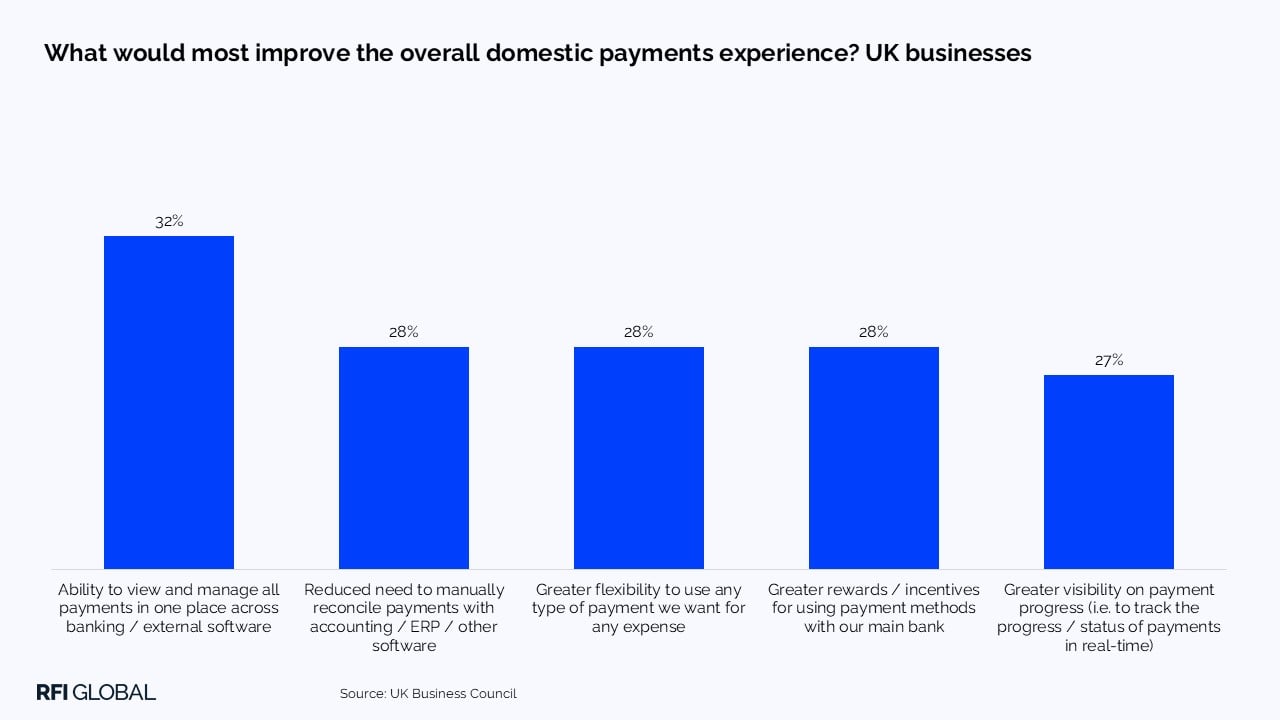
Data from RFI Global’s UK Business Payments Council demonstrates that the number one area for improvement in the domestic payments experience is the ability to manage all payments in one place – across banking and external software. A third of businesses interviewed (32%) feel this would most improve their domestic payments experience.
The key insight here is not necessarily that all businesses want every payment visible on their banking software, or that they want every payment on an external software. It varies substantially. Even two businesses with the same profile in terms of revenue, industry, region, or even the individual decision maker in a business might prefer one solution over the other.
Understanding the complexities of businesses’ integration needs is a topic in its own right, but it is clear that unified management is a key issue for businesses. The main reason behind this desire for improvement is to save businesses’ time. Reducing the manual reconciliation process is a much-wanted improvement for over a quarter of businesses (28%) – being able to flexibly use any type of payment method for any expense. This matters for banks and financial institutions because it indicates a key shift in payments. The method of payment is less of an issue than the means by which payments are managed.
Creating payment solutions to match business needs
Creating a perfect solution that meets the needs of every business is a near, if not totally insurmountable, task due to the immense variation in solutions and preferences. Fortunately, this is not the route that needs to be taken. Businesses already have enough solutions to use. One in four UK businesses are multi-banked, and additionally, businesses have accounting software, acquiring, enterprise resource planning (ERP) solutions, inventory management, logistics management, CRM solutions, ecommerce solutions, POS systems… and more. With so many solutions already available, trying to create one tool that captures everything is something certain brands have been working on for decades.
Instead, our data shows that the focus needs to be on granting businesses the flexibility to manage payments, holistically, in the tool that they prefer. There isn’t a strong preference for banking to be integrated into external software, or vice-versa.
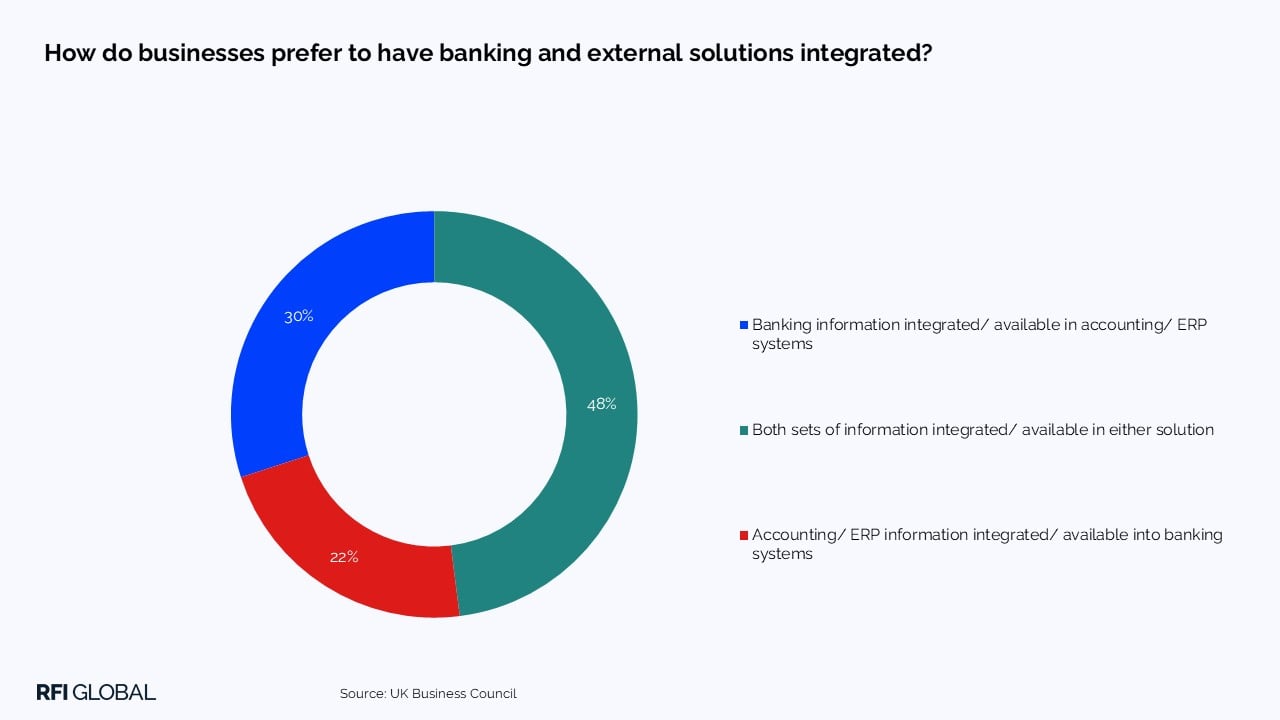
Most businesses (48%) want to have both sets available in either solution – i.e., omni-directional integration. What this data does not show is that everything, everywhere, all at once needs to be integrated. Instead, it reflects the latent need for flexibility among UK businesses. There isn’t a uniform direction for integration – it varies down to the level of individual decision makers in the same business.
If integration is omnidirectional, what actually matters?
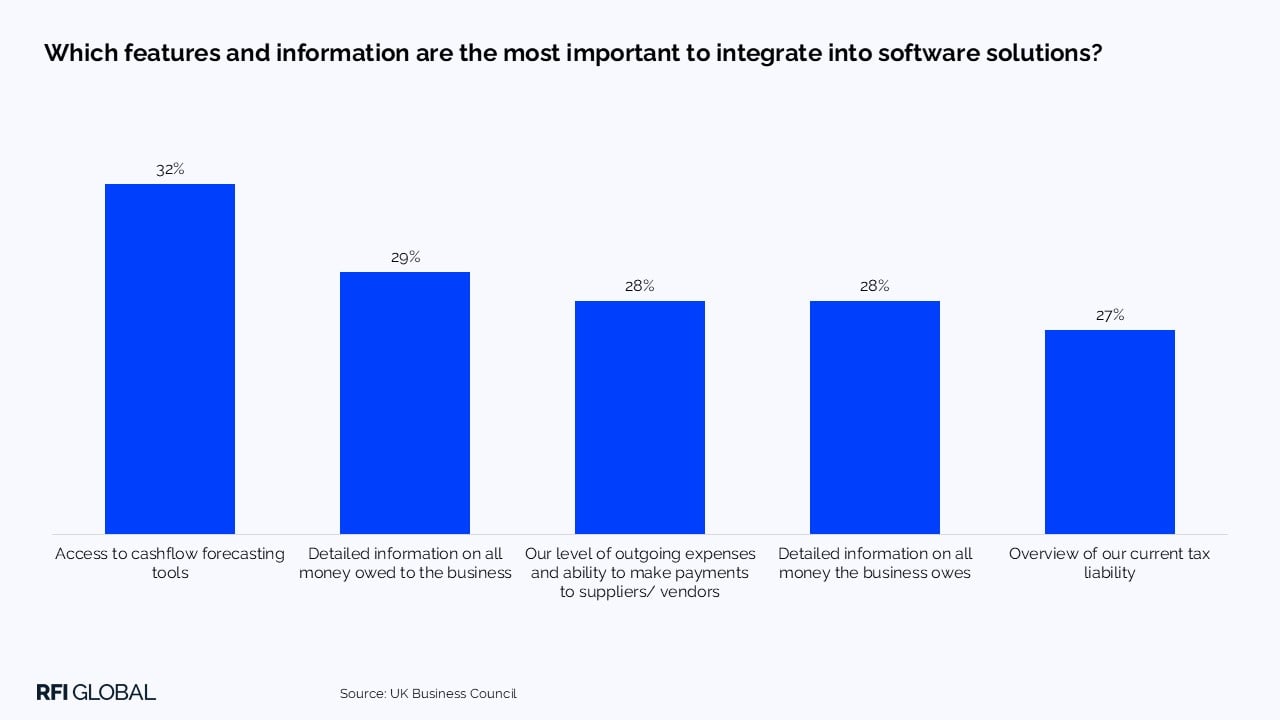
Our data shows clear priorities on what should be integrated. Access to cashflow forecasting tools is the most desired integration (32%), regardless of the direction of integration.
The preference for cashflow forecasting tools indicates another latent need – a desire for greater visibility, predictability and insight from the data a business already has. This is the true characteristic of the new intelligence revolution. Data is not the new gold but instead the new oxygen for businesses. A seamlessly integrated solution that enables holistic payments management, with information on money in and out, incorporating tax liabilities and forecasting? While this isn’t perhaps needed for the one-man-band gardeners of the UK, it is undoubtedly needed for the scaling SMEs that will drive the economy through the intelligence revolution.
Holistic payments management will unlock the next phase of UK business growth
UK businesses are looking for digital payment tools that streamline their operations, provide insight into these operations and drive their next phase of growth. The UK has maintained its reputation as a global financial innovation hub despite the trials and tribulations over the last 10 years. RFI Global has been helping financial institutions worldwide to understand the payments landscape and advise on effective change for two decades and will continue to do so throughout the next stage of the payments revolution.
For more information on how RFI Global can help your business drive effective payment strategies, get in touch for further insights from the study.

Joseph Sharangparni
Senior Insights Manager, EMEA & North America
Joseph Sharangparni is a Senior Insights Manager at RFI Global, delivering research across EMEA and North America.
View full profileFrequently Asked Questions about UK payments
Q: What do SMEs want from their payment providers?
UK businesses want the ability to manage all payments in one place, across both banking platforms and external software. RFI Global data shows around a third of businesses prioritise unified payment management to improve efficiency and reduce manual processes.
Q: Why is payment fragmentation still a challenge for businesses?
Payment fragmentation persists due to the growing number of systems businesses rely on, including banking, accounting, ERP and payment solutions. This creates complexity in managing money in and out, increasing manual reconciliation and reducing operational efficiency.
Q: Do businesses want all payments integrated into a single platform?
Not necessarily. RFI Global data show that businesses do not have a uniform preference for where payments should sit. Instead, they want flexibility to manage payments in their preferred environment, whether within banking platforms or external software.
Q: What is driving demand for payments management for SMEs?
The key driver is the need to save time, reduce manual reconciliation and improve visibility across all financial activity. As payment options expand, businesses are increasingly focused on how payments are managed, rather than the specific method used.
Data-driven insights for financial service leaders
Subscribe to The Banknote, our monthly newsletter delivering expert perspectives and exclusive analysis, powered by 200,000 consumer and 60,000 business interviews each year to help you stay ahead in a fast-changing financial world.
