
The story of the bank branch has been, until recently, one of decline.
As digital banking became the default for everyday transactions, many institutions questioned how much physical presence they still needed.
If you just look at transaction volumes, the conclusion seems obvious: branches matter less now than they did in the past. But what if the value of the branch is being measured using the wrong metrics?
For some, its value is the reassurance of knowing help is nearby; for others, it is a source of guidance when a major financial decision carries unfamiliarity or risk. This shift means the branch can no longer be designed around a single, universal purpose.
Innovation Monitor, RFI Global’s nationally representative study of over 4,000 US consumers, suggests that while consumers need branches less often than they once did, they value them more than many institutions realize. The reason, however, has little to do with routine banking. The future of the branch is not transactions. It is confidence. And that distinction could fundamentally change how banks think about their physical networks.
Consumers don’t use branches because they struggle with digital banking
One of the most persistent myths surrounding branch banking is that visits are largely driven by consumers who struggle with digital channels. That belief is increasingly outdated.
Today’s consumers transfer money, deposit checks, apply for products and manage most aspects of their financial lives through digital channels. 82% of consumers use digital banking channels at least once a week.
Yet despite the move to digital, branch access remains one of the top five reasons consumers choose their primary banking provider. Innovation Monitor shows that nearly one-third of US consumers (32%) cite convenient branches and ATMs as a factor when selecting their main bank, ranking it ahead of digital banking quality and promotional offers that often dominate acquisition strategies. That raises an obvious question. If consumers are doing more online than ever before, why does physical presence continue to influence bank choice?
The answer appears to be emotional. Consumers may not intend to use branches regularly, but they want to know they are there. Much like insurance, the value is often found in access rather than utilization. The branch provides reassurance that support exists if something important happens, a significant difference from the industry’s traditional view of branches as transaction centers.
The most important branch users aren’t who you think they are
An intriguing finding from the study is a contradiction that initially appears to make little sense.
- Older consumers place the greatest value on branch access – almost half of consumers aged 65 and over say branch proximity influences their choice of primary bank. Yet they are the least likely to visit a branch regularly.
- Consumers aged 18-24 tell a different story. They place significantly less importance on branch access when choosing a bank, yet they visit branches almost twice as often as older consumers.
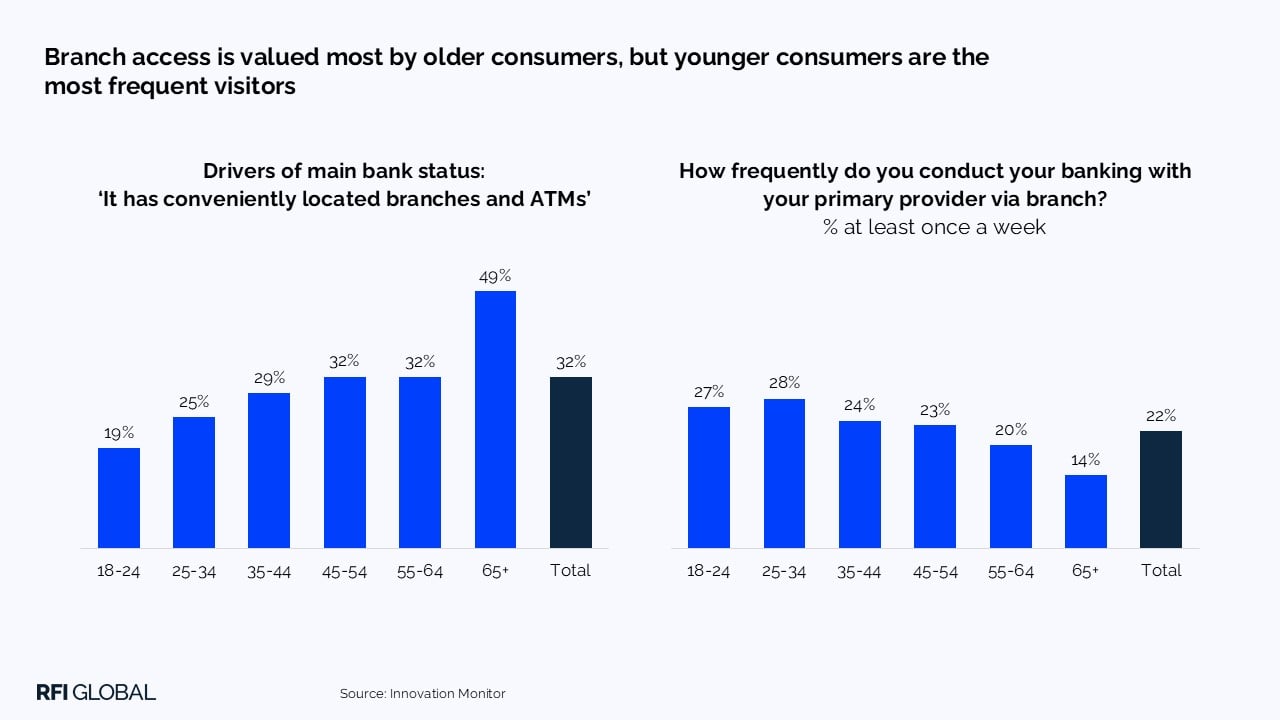
Older consumers appear to value the branch as a safety net. They want it nearby, but only occasionally need to use it. Its value comes from reassurance. Younger consumers treat the branch differently. They grew up with digital banking and expect routine tasks to happen online. They visit a branch when something important happens; 18% of 18- 24-year-olds say branches are valuable for support during major life events, compared with just 4% aged 65+. They prefer the branch when buying a first home, taking out a loan, opening an investment account, or navigating an unfamiliar or risky financial decision.
Branches serve a different purpose than they once did. They are evolving from places where consumers conduct banking to places consumers seek certainty. The implication is significant. A single branch model is unlikely to meet the needs of both groups. Older consumers seek accessibility and reassurance, while younger consumers are looking for advice and support during key life events. Future branch strategies should reflect those differing needs.
The branch dilemma isn’t about technology
The banking industry often responds to branch challenges by investing in technology. New screens, self-service kiosks, digital appointment systems, modernized layouts, etc. Yet our data suggests the greatest weaknesses in the current branch experience have little to do with technology at all. The strongest drivers of branch satisfaction are appointment availability, opening hours, waiting times and whether staff understand a customer’s needs. In fact, one of the lowest-scoring areas is consumers feeling recognized and understood by branch staff, despite this being one of the strongest predictors of overall satisfaction.
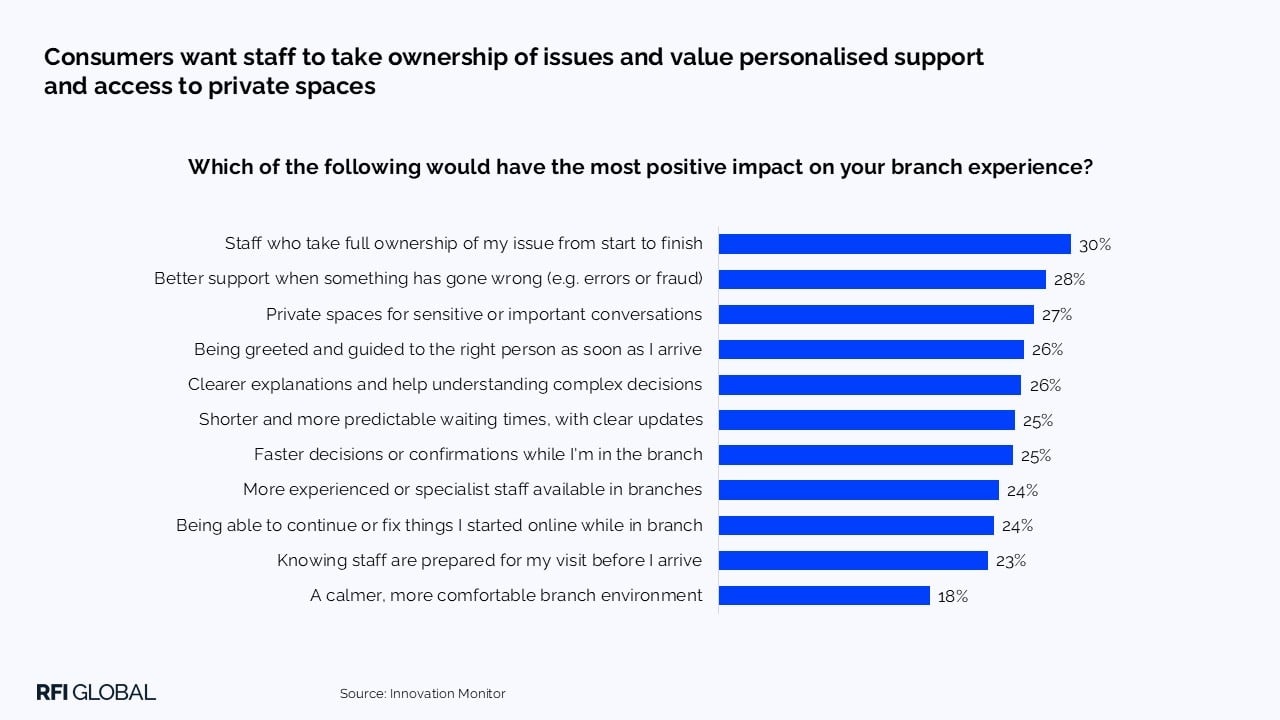
This should be a wake-up call for financial institutions. Many branches are already clean, safe and well maintained. Consumers largely acknowledge that. What appears to be missing is not operational competence but human support. Increasingly, the branch experience is judged less like a retail transaction and more like a professional service. Consumers want expertise and advice. The most requested branch improvement is having staff take ownership of an issue from start to finish, cited by 30% of consumers. They want somebody who understands their situation and can guide them through the process.
Wait times are really a trust issue
The strongest evidence for the branch’s emotional role comes from an area many banks view as operational: wait times. Conventional wisdom suggests that reducing wait times improves convenience. Our data suggests something more powerful is happening.
When consumers are satisfied with wait length, the proportion leaving a branch feeling reassured and confident rises from 18% to 31%, while the proportion leaving feeling anxious or uncomfortable falls from 11% to 5%. Feelings of frustration and anxiety fall sharply.
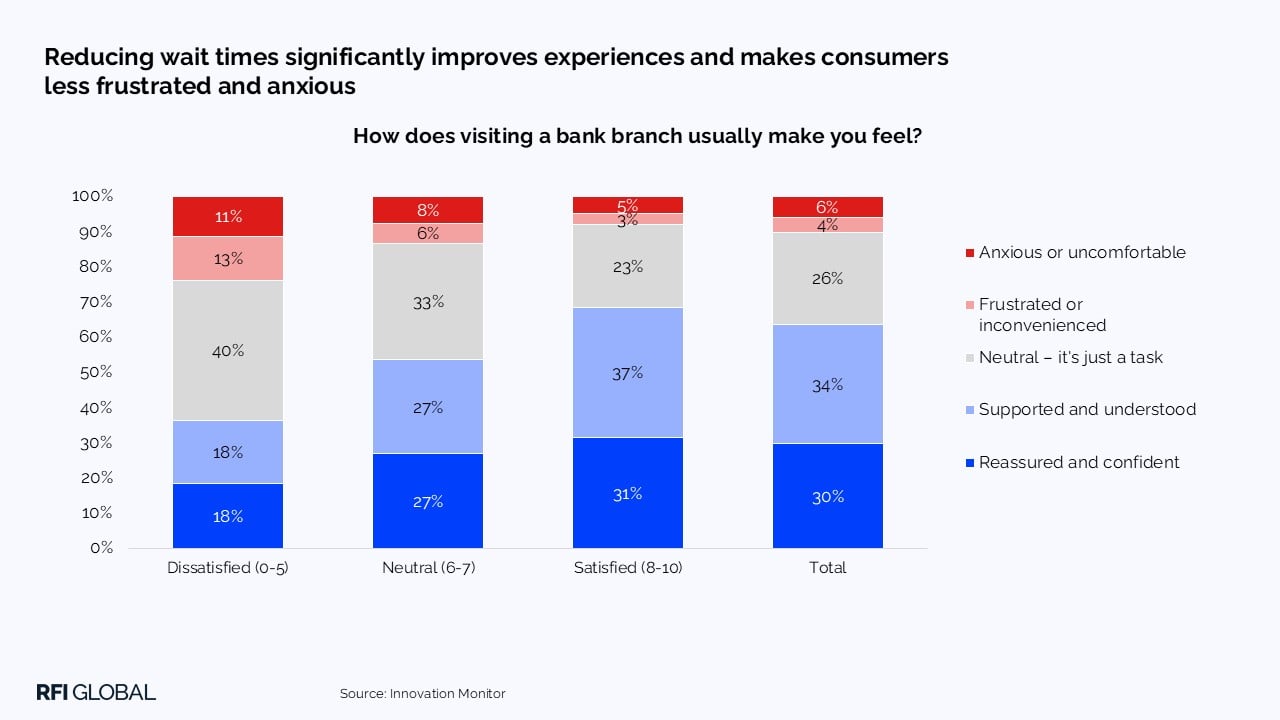
That is a remarkable outcome for what initially appears to be a relatively simple service issue. It suggests waiting is not just about efficiency. It becomes a signal. Long waits can make consumers feel unimportant, uncertain or unsupported. Short waits communicate responsiveness and control.
Trust is shaped by dozens of small interactions that collectively influence how customers feel, not just through products, pricing or brand reputation. The branch remains one of the places where those emotions are experienced most directly.
The branch isn’t disappearing. It’s specializing.
The strongest evidence for this comes from product purchase journeys.
Overall, more than one-third of consumers (38%) visit a branch when researching or applying for a financial product. For mortgages, that rises to 50%. Investment accounts produce a similar pattern. The common characteristic across these products is not complexity alone, it is consequence.
Consumers can recover from choosing the wrong credit card. Choosing the wrong mortgage or making a poor investment decision is different. The stakes are higher.
What is particularly revealing is that many consumers begin their journey digitally before moving into a branch. They compare products online, conduct research and narrow their options. Yet when it comes time to commit, they often seek human guidance, reassurance or confirmation before proceeding.
This suggests the future of the branch is not competing with digital channels. It is complementing them. Digital channels, alongside AI assistants, are becoming increasingly effective at helping consumers make decisions. Branches remain uniquely effective at helping consumers feel comfortable with those decisions.
A different way of thinking about branches
For years, the question facing the industry has been whether consumers still need bank branches. However, Innovation Monitor suggests that may no longer be the right question. What matters now is understanding the moments when the branch still adds real value.
Consumers rarely need branches to withdraw cash, check balances or transfer money. Digital channels have solved those problems. What consumers still need is confidence. They need it when making financial decisions that carry risk, emotion or long-term consequences. They need it when something goes wrong. They need it when reassurance matters as much as convenience.
That is why predictions about the death of the branch continue to miss the mark. Branches are not disappearing; they are evolving into something far more specialized and, potentially, far more valuable than before.
In a market where many decisions begin online before moving to branch, it is increasingly vital that these experiences are complementary and the transition from online to offline is seamless.
The institutions that succeed in the coming decade may not be those that operate the largest branch networks, or those that close them fastest. They may be the institutions that recognize the branch for what it is becoming: not a place to process transactions, but a place to create confidence.
Get in touch for further insights from Innovation Monitor.
Frequently Asked Questions about bank branches
Q: Why do bank branches still matter in a digital world?
While most routine banking activities have shifted to digital channels, bank branches continue to play an important role in customer acquisition, trust and decision-making. RFI Global’s Innovation Monitor found that 32% of US consumers consider convenient branch and ATM access when choosing a banking provider. Branches increasingly provide confidence, reassurance and support during important financial decisions rather than serving as transaction centres.
Q: What is the future role of the bank branch?
The future role of the bank branch is evolving from processing everyday transactions to supporting high-value customer interactions. Consumers are most likely to use branches when seeking guidance on significant financial decisions, resolving complex issues or gaining reassurance before committing to a product. Branches are becoming specialised destinations for advice, confidence and human support.
Q: Do younger consumers still use bank branches?
Yes. Contrary to common assumptions, younger consumers remain active branch users. RFI Global’s research shows consumers aged 18-24 visit branches almost twice as often as those aged 65 and over. However, they use branches differently, typically seeking support during major life events such as buying a first home, taking out a loan or opening an investment account.
Q: What drives branch satisfaction and customer trust?
The strongest drivers of branch satisfaction are not technology features but human factors, including appointment availability, opening hours, waiting times and staff understanding customer needs. Consumers place particular value on branch employees taking ownership of issues from start to finish. These interactions help build trust, confidence and reassurance during important moments in the customer journey.
Q. How should banks measure branch performance?
Traditional branch metrics such as transaction volumes may no longer capture the full value of a branch network. As branches become more focused on advice, reassurance and complex financial decisions, banks should also consider measures such as customer confidence, support during key life events, problem resolution and contribution to product purchase journeys. The most successful institutions will be those that align branch strategy with the moments where human support creates the greatest value.
Q. How do branches fit into a cross-channel banking strategy?
Branches increasingly complement digital banking rather than compete with it. Many consumers begin researching financial products online before moving to a branch for guidance, validation or reassurance before making a decision. Effective omnichannel banking strategies create a seamless transition between digital channels and branch interactions, ensuring customers can move easily between self-service and human support.
Data-driven insights for financial service leaders
Subscribe to The Banknote, our monthly newsletter delivering expert perspectives and exclusive analysis, powered by 200,000 consumer and 60,000 business interviews each year to help you stay ahead in a fast-changing financial world.
