

Jackie Greig, VP Marketing, Global
Mid-market enterprises (MMEs, defined here as businesses with annual revenue between $10m and $500m) are often described as banking’s ‘missing middle’. Larger and more complex than traditional SMEs (<$10m), they require more sophisticated support, yet they are often too small to receive the attention and service models typically reserved for corporate clients. They represent a sizeable and often overlooked opportunity for financial institutions as their businesses expand.
Our data show that MMEs generally report high satisfaction with their banks worldwide, with particularly strong results in the UK and the US. So, the challenge for banks is not simply attracting MMEs, but deepening relationships as their needs evolve and their businesses grow. Australian banks have more work to do, with satisfaction sitting at 58%.

Digital-first, but not digital-only
Both MMEs and SMEs are highly digital. In most markets, over half use mobile and online banking regularly as part of their day-to-day operations. However, traditional channels continue to play a role, particularly in Western markets where between 13% and 18% of businesses still use branches frequently. Branch usage is far lower among MMEs in Asia, with frequent usage sitting at just 1% in Hong Kong, 4% in Malaysia and 6% in Singapore.
While digital channels increasingly dominate routine banking activity, businesses still value access to human support when they need it.
Relationship management matters
Relationship managers remain a prominent part of the service model for MMEs. Access is widespread across markets and, in Western markets (UAE 85%, Canada 84%, UK 80%), significantly higher than among SMEs. The proportions are lower in Asia, but closer to the levels for SMEs (MMES: Malaysia 77%, Hong Kong 75%, Singapore 73%).
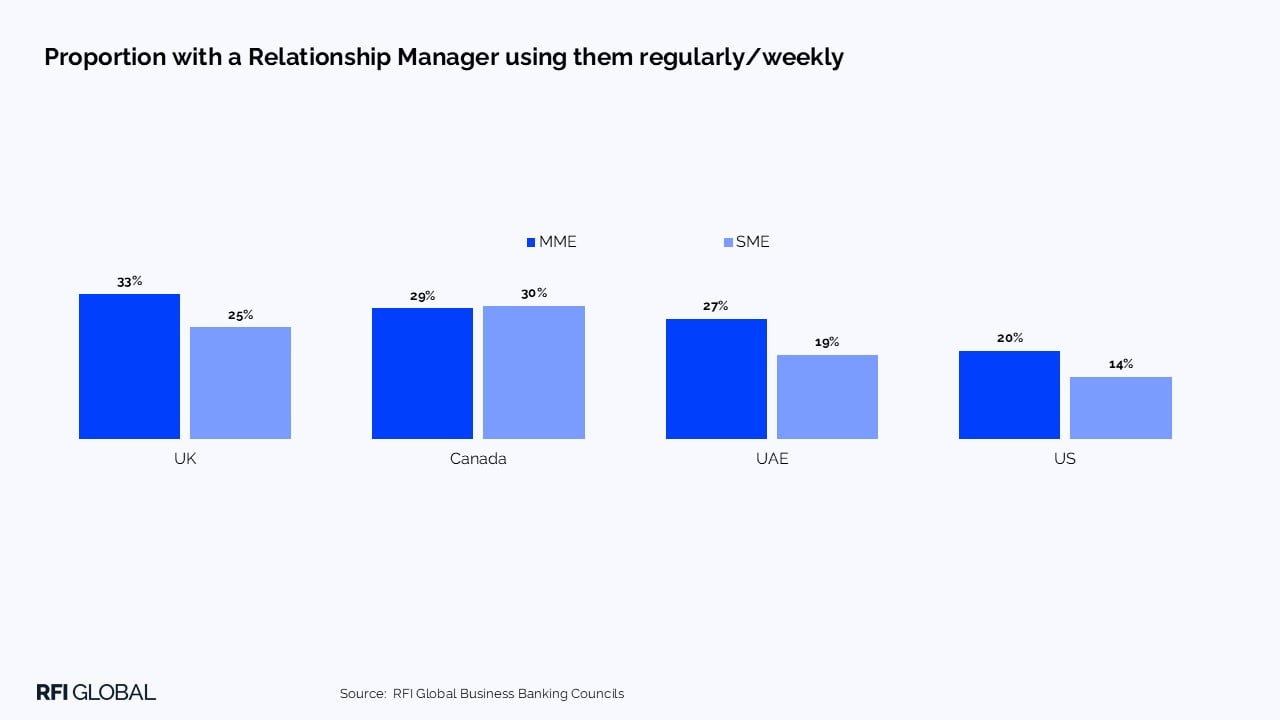
These are not dormant relationships – between a quarter and a third of MMEs engage with their relationship manager regularly, highlighting the continued importance of expert guidance alongside digital servicing. Relationship managers provide an important channel for banks to engage customers beyond routine transactions and support them through periods of change and growth.
A challenging environment
The main challenges for both MMEs and SMEs are growth, increasing competition and managing cash flow. However, increased competition is more of a concern for MMEs than SMEs and growing revenue is more of a priority amongst SMES.
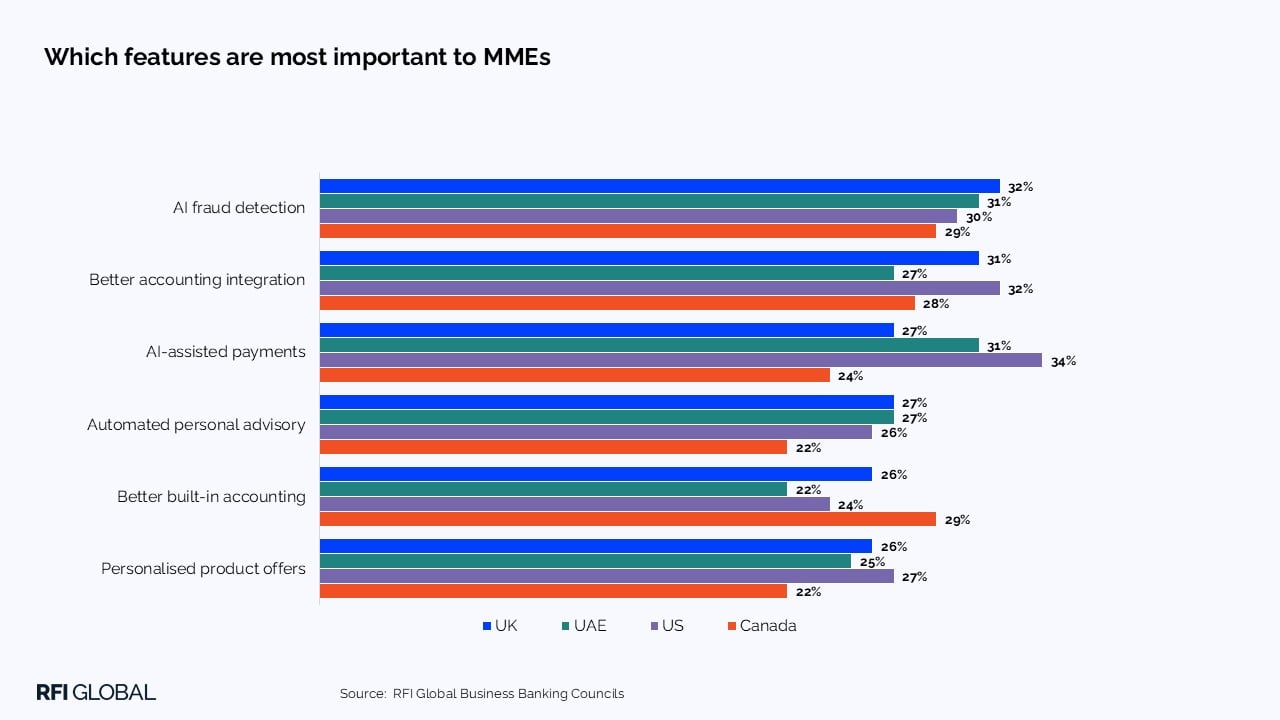
Cybersecurity is also a significant concern in the UK and Canada and is more pronounced among MMEs. When asked which banking features they value most, AI-powered fraud detection was at the top, or close to the top of the priority list for MMEs.
This aligns with findings from RFI Global’s iSky Radar UX platform, which show that leading financial institutions are moving beyond basic fraud alerts towards more proactive and integrated protection. From contextual payment warnings and customer-controlled security settings to clearer visibility of account activity, the focus is increasingly on helping customers recognise risk early and act with confidence.
Digital innovation focused on efficiency
A demand for greater digital innovation is front and centre in MMEs’ minds. Better accounting integration, built-in accounting capabilities and AI-assisted payments are also priorities. This is less about adding new features and more about reducing friction. As businesses become larger and more complex, they need banking services that integrate seamlessly into existing workflows, providing better visibility, control and efficiency. Increasingly, businesses expect their financial institution to fit into the way they operate, rather than requiring them to adapt their processes around separate banking tools.
Personalised product offers are also valued by MMEs. As businesses become larger and more complex, they increasingly expect banks to understand their needs and provide relevant products, insights and support at the right time. The opportunity is to deliver solutions aligned to a business’s circumstances, ambitions and stage of growth.
In the US, better accounting integration and AI-assisted payments stand out as particularly important, while Canadian MMEs place greater emphasis on built-in accounting capabilities. The common thread is a desire for banking services that cut administrative effort, automate routine tasks and integrate more seamlessly into existing business workflows.
Supporting growth
While digital capabilities are increasingly important, MMEs also place a high value on the broader banking relationship. Across markets, some of the strongest drivers of advocacy are commitment to long-term business growth, service quality and having the right range of products to meet business needs. In several markets, these factors are cited by around eight in ten MMEs.
Transparency in decision-making and proactive advice also rank highly. In the UK, UAE and Canada, around three-quarters of MMEs cite transparency as an important driver of advocacy, while proactive advice also scores strongly.
The findings suggest that while MMEs value efficient day-to-day banking, they also place significant importance on the quality of support they receive as their businesses become more complex.
How to win the MME opportunity
The opportunity with the mid-market lies in combining digital efficiency with meaningful relationship support to help businesses operate more effectively and grow. MMEs value tools that simplify financial management, improve visibility and fit seamlessly into existing workflows, but they also place significant importance on advice, transparency and support for long-term growth. Features such as accounting integration, built-in accounting capabilities, AI-assisted payments and AI-powered fraud prevention are no longer nice-to-haves. They are increasingly defining how businesses evaluate their banking relationships.
Relationship management continues to play an important role. While digital channels dominate day-to-day banking, many MMEs regularly engage with relationship managers, highlighting their appreciation of expert support as they become larger and more complex. The most successful institutions will be those that use digital tools to remove friction and improve efficiency, while enabling relationship managers to focus on higher-value conversations around growth, strategic priorities and changing business needs.
RFI Global’s business banking research captures the views of over 60,000 SMEs and MMEs worldwide. Get in touch for further insights from our data into what drives satisfaction, advocacy and growth in your market.

Jackie Greig
VP Marketing, Global
Jackie Greig is the Global VP of Marketing at RFI Global. She is a senior marketing and market research leader with extensive experience building global marketing strategies for financial services brands.
View full profileFrequently asked questions about mid-market business banking
Q: What do mid-market enterprises want from their banks?
Mid-market enterprises want digital tools that simplify financial management alongside relevant human support. Priorities include accounting integration, built-in accounting capabilities, AI-assisted payments, fraud prevention, transparent decision-making and proactive advice. MMEs also value financial institutions that understand their changing needs and support long-term business growth.
Q: How can banks grow their relationships with mid-market businesses?
Banks can grow MME relationships by combining efficient digital banking with effective relationship management. Digital tools should reduce administration, improve visibility and fit into existing business workflows. Relationship managers can add value by focusing on growth, strategic priorities and more complex banking needs rather than routine transactions.
Q: How important are relationship managers to mid-market enterprises?
Many MMEs regularly engage with relationship managers despite the widespread use of mobile and online banking. As businesses grow and their financial needs become more complex, relationship managers provide direct access to expertise and support. Digital servicing and relationship management therefore play complementary roles in the MME banking experience.
Q: Which digital banking features are most important to MMEs?
MMEs place particular importance on better accounting integration, built-in accounting capabilities, AI-assisted payments, AI-powered fraud detection and personalised product offers. These features can reduce operational friction, strengthen control and help businesses manage increasingly complex financial activity.
Data-driven insights for financial service leaders
Subscribe to The Banknote, our monthly newsletter delivering expert perspectives and exclusive analysis, powered by 200,000 consumer and 60,000 business interviews each year to help you stay ahead in a fast-changing financial world.
