

Dan Latimore, Head of Research, North America
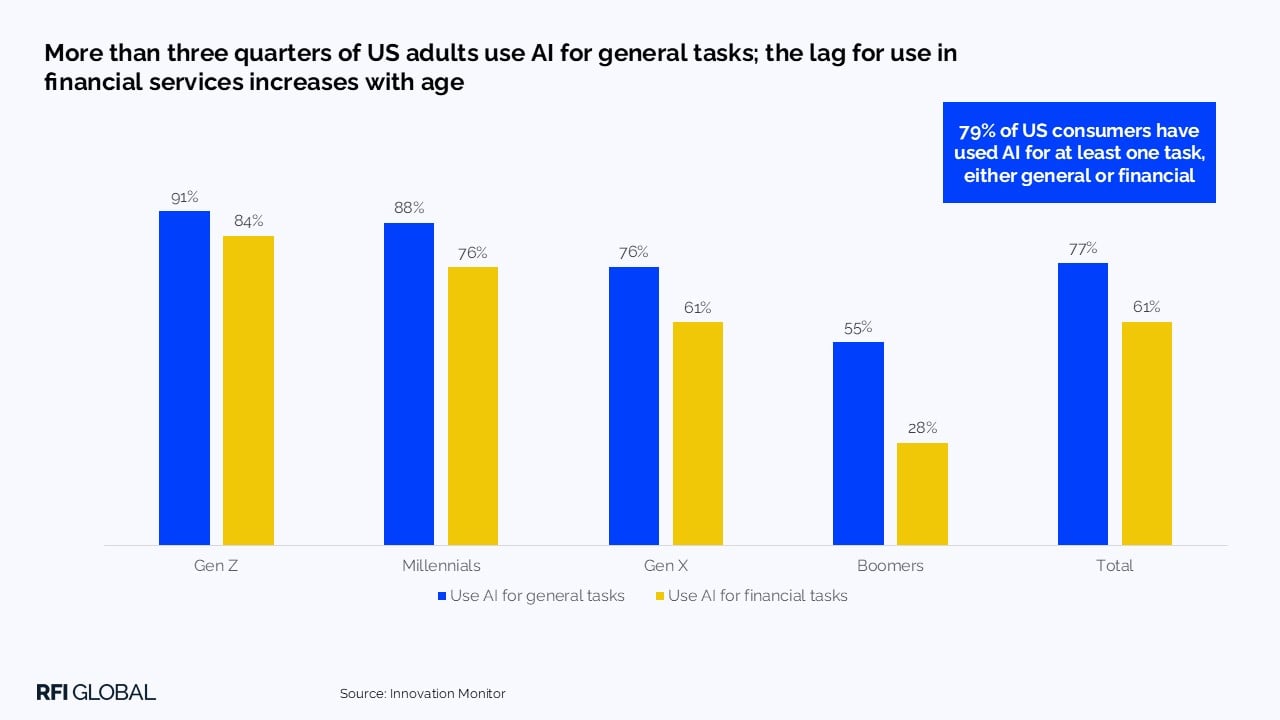
Attitudes towards the use of AI in financial services have evolved rapidly for US consumers. 18 months ago, we wrote that only 17% of consumers in our MacroMonitor survey were very comfortable using AI for banking tasks. Today, 80% of Gen Z and Millennials use it for at least one banking task, although this behavior is not universal; only 28% of Boomers use it for banking.
There’s not yet a use-case that’s broken away from the pack; ’General information or research’ is the highest-ranked category, with 49% of the population citing it as a use case. In financial services, ’Understanding financial terms or documents’ was the most popular use case at 21%. The use of AI to research and guide financial decisions is growing; banks and other providers need to decide how to position themselves in an AI-enabled world across the customer lifecycle, from product discovery through to customer service, while also determining their stance toward the significant portion of the older population that has yet to try financial AI.
Our latest US survey, Innovation Monitor, tracks evolving trends in US financial services, including detailed insights into consumer use of AI for financial and non-financial tasks. Our early analysis of the results highlights five key points around AI.
Key takeaways
1. AI is mainstream, but financial services use still lags behind broader adoption.
2. Consumers use AI across many tasks, with no single dominant use case.
3. Older consumers remain an untapped opportunity for financial AI.
4. Once consumers start using AI for finance, they move quickly beyond research.
5. Understanding evolving AI behaviors will be critical for future growth.
1. AI has gone mainstream—including financial services
AI is no longer an emerging technology. For most consumers, it’s already part of daily life. We asked, ’Which best describes how you currently use AI tools (e.g. chatbots or assistants) in banking or financial services, or your everyday life?’ Consumers’ willingness to try AI is high, with 79% of them using at least one AI tool, whether general or financial. Use is much higher among the younger cohorts – Gen Z and Millennials – than among Gen X and Boomers, where there is a significant drop-off, with only 57% of adults over 60 using an AI tool.
AI adoption has moved beyond experimentation. While usage varies by age and task, a large majority of consumers have now engaged with AI in some form, creating a growing expectation that financial providers will meet them in an AI-enabled world.
2. Consumers use AI for a wide variety of financial tasks
While almost 80% of the population has used an AI tool, how they use it differs greatly, as the most popular task, ‘General information or research,’ is used by only 49% of the population, followed by ’Work or productivity tasks’ at 30%. In every category save ’Writing or debugging computer code’ the use of AI for day-to-day tasks surpasses that of financial services.
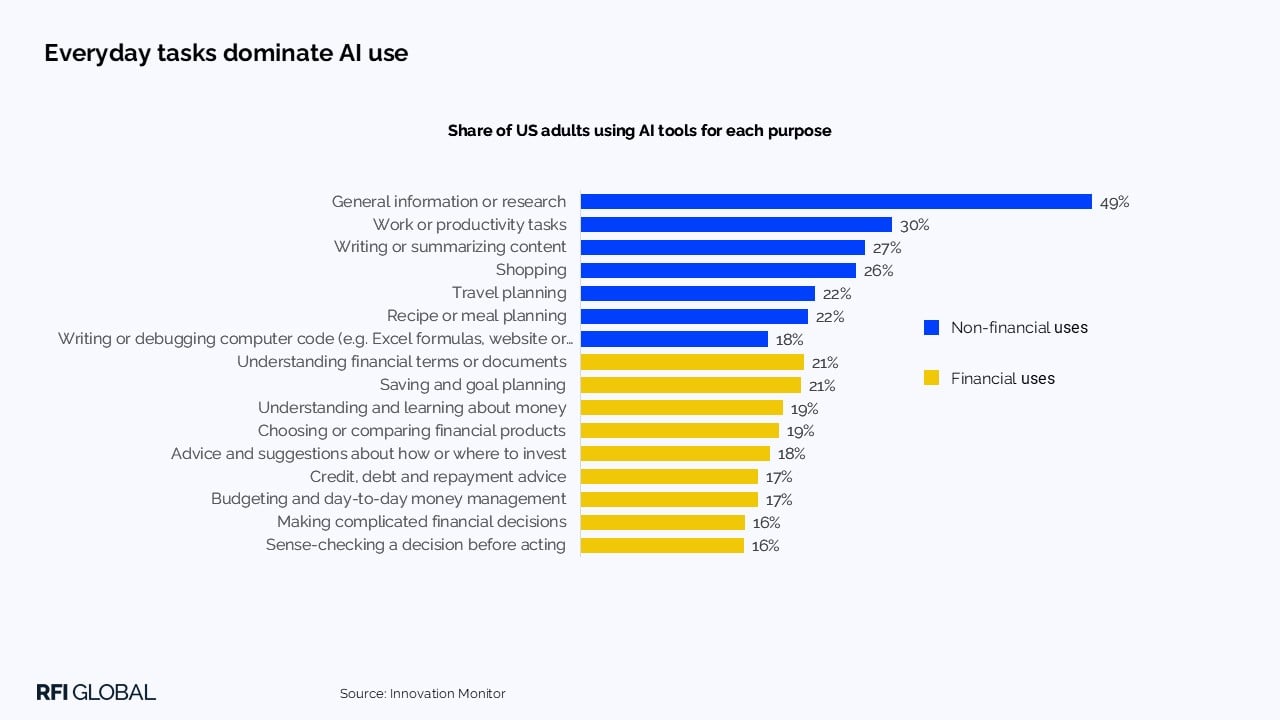
While AI adoption for financial services is today somewhat lower than everyday tasks, this is an area undergoing rapid change. Within financial services, our nine activities are clustered tightly between 16% and 21%. 61% of the overall population has executed at least one of these tasks, suggesting that their usage is widely dispersed.
3. Older adults are an opportunity
A large portion of older adults – 39% of Gen X and 72% of Boomers – have yet to use AI for financial services, suggesting a chance to attract new users. Some may not have been exposed to AI, while others may be skeptical of the technology. It’s noteworthy that the ratio of non-users to users is so high relative to Gen Z and Millennials. As comfort with AI grows, understanding which use cases resonate most strongly with older customers will become increasingly important.
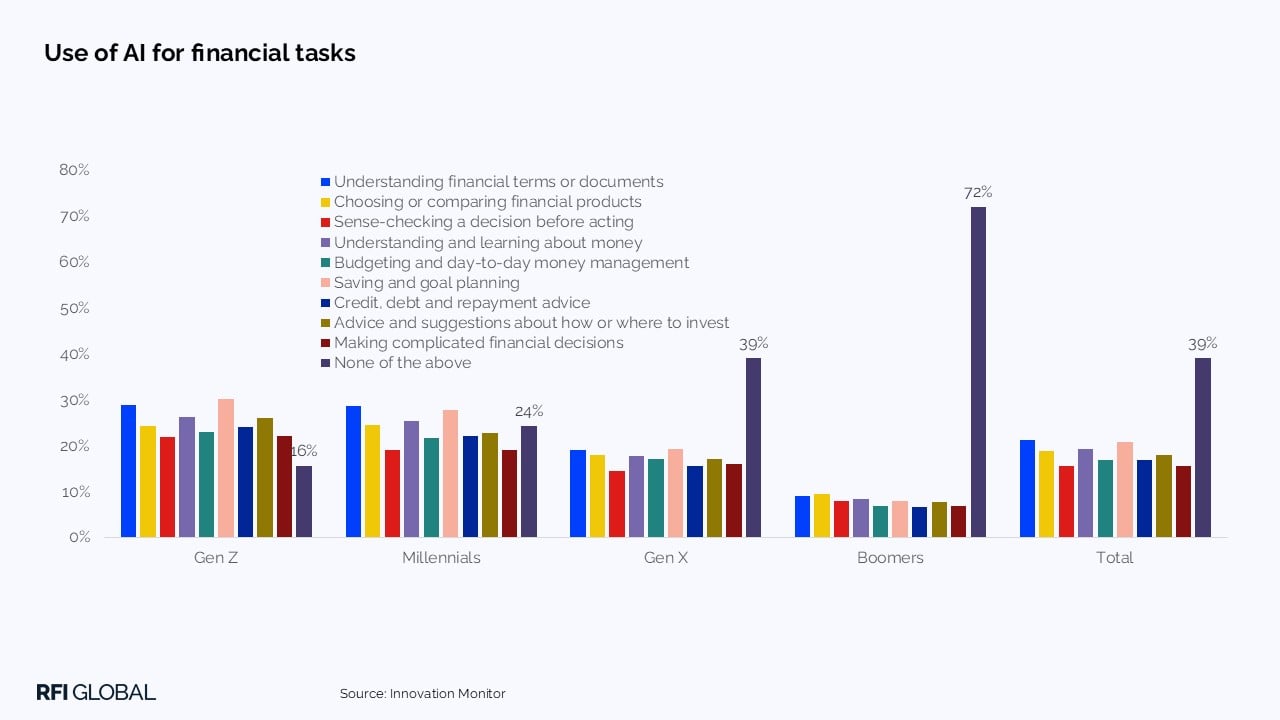
Younger consumers have tried a wide variety of use cases; few of them (16% Gen Z and 24% of Millennials) haven’t used AI at all. Data from our MacroMonitor survey show that A third of Americans (32%) say regular audits would make them more comfortable with AI-powered financial services, with 54% concerned about the accuracy of AI-based decision-making. Transparency and bias checks would help to build trust.
4. Once consumers start using AI for finance, they don’t stop at research
Our nine different financial tasks can be roughly categorized as research or action. The small gap between research and action suggests that consumers who are willing to try AI don’t see it solely as an information source. Once they begin using it to understand financial concepts or explore options, many are willing to use it for planning and decision-making. For financial institutions, this highlights how quickly AI can become embedded in financial behaviors once trust is established.
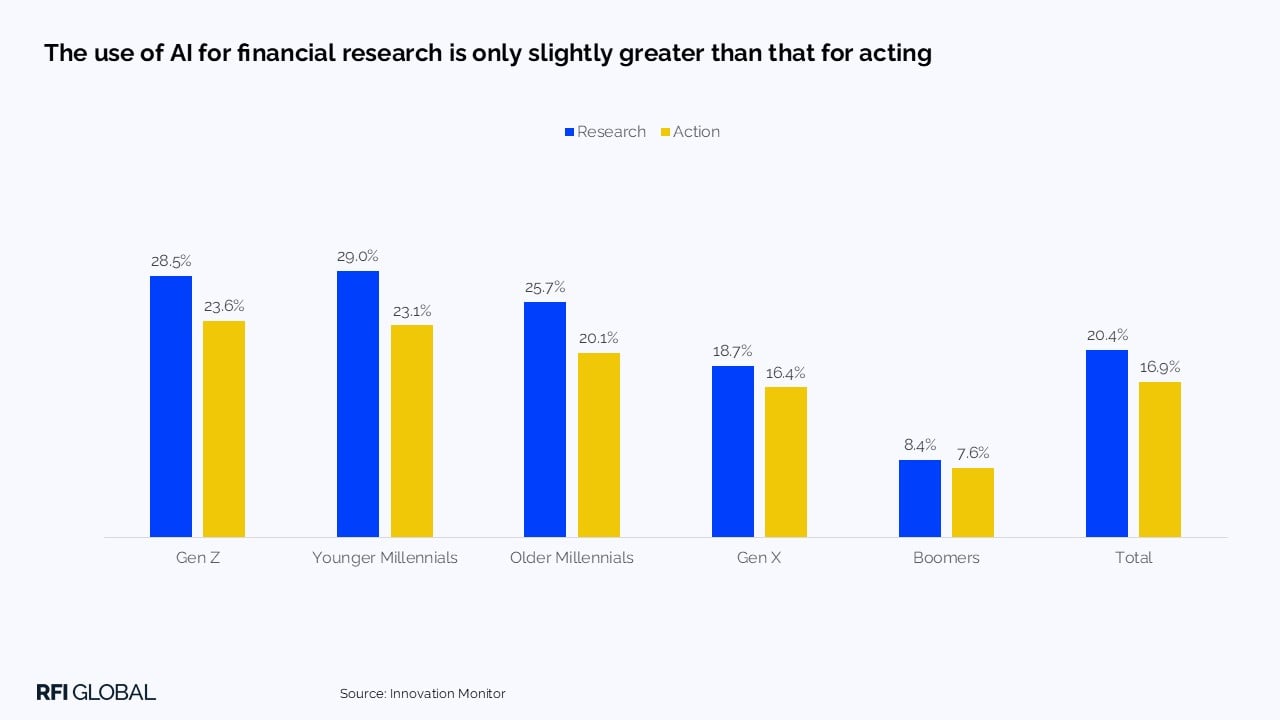
We hypothesize that AI adoption for financial services will continue to increase, particularly once US institutions address consumer concerns about AI-powered financial services. MacroMonitor data show that privacy and data security, accuracy, and lack of human interaction were the primary concerns of US consumers at 55%, 54%, and 53% respectively.
What, then, should financial services firms do?
5. Implications for financial institutions
AI is still in its infancy in customer-facing financial services, yet significant adoption has already occurred. As more institutions begin to roll out native tools for customer use, and as LLMs focus their attention on finance-specific use cases, attitudes and uptake will change. Given this rapid evolution, we have three recommendations for financial institutions based on Innovation Monitor data.
- Recognize that AI will affect every aspect of the customer lifecycle and will proceed with or without bank involvement. Even if you’re not building or providing access to bank-specific tools, customers will be using off-bank AI to research and plan; you need a strategy to make sure you surface in those conversations.
- Be transparent about your use of AI, especially in cases like fraud detection, where it’s doing good work behind the scenes. Over time, this will increase comfort with AI adoption.
- Adapt to a new mode of customer interaction. Just as retail shopping experiences shaped expectations for financial services in the early days of the internet, GenAI interactions are shaping how consumers research questions and generate ideas. AI users are becoming used to crafting prompts to get their answers instead of filling out questionnaires.
How will you adapt to this new way of interacting? As AI becomes increasingly embedded in financial decision-making, understanding evolving consumer behaviors has never been more important.
Get in touch for further insights from Innovation Monitor on the trends driving US consumer behaviour in financial services.
About Innovation Monitor
This data is from Innovation Monitor, RFI Global’s latest survey that generates timely insights into evolving attitudes and behaviors based on a survey of 4,000 US consumers. Focused on the industry’s most important and fast-moving topics, it delivers actionable insight across regions, generations and wealth segments, helping you identify emerging trends early and make confident, informed decisions.

Dan Latimore
Head of Research, North America
As Head of Research, North America for RFI Global, Dan helps clients make fact-based decisions about consumer behaviour and sentiment rooted in broad and deep primary research from MacroMonitor, Innovation Monitor and iSky.
View full profileFrequently Asked Questions about AI in financial services
Q: What percentage of US consumers are using AI?
According to RFI Global’s Innovation Monitor, 79% of US consumers have used at least one AI tool for either everyday or financial tasks. Adoption is highest among younger consumers, while usage remains significantly lower among older generations.
Q: What does the growing consumer use of AI mean for financial institutions?
As AI becomes more embedded in how consumers research, evaluate and make financial decisions, financial institutions need to understand evolving customer behaviours, ensure they remain visible throughout the customer journey and adapt to changing expectations around digital interaction and engagement.
Q: How are US consumers using AI for financial services?
Consumers are using AI across a broad range of financial activities, including understanding financial terms and documents, learning about money, savings and goal planning, and other research and decision-support tasks. No single financial use case dominates, suggesting adoption is spread across multiple needs.
Q: How are consumers using AI to make financial decisions?
US consumers are using AI across a wide range of financial activities, including understanding financial terms and documents, learning about money, savings and goal planning, and other research and decision-support tasks. No single use case dominates, suggesting AI is becoming a tool that supports multiple stages of the financial decision-making process.
Data-driven insights for financial service leaders
Subscribe to The Banknote, our monthly newsletter delivering expert perspectives and exclusive analysis, powered by 200,000 consumer and 60,000 business interviews each year to help you stay ahead in a fast-changing financial world.
