

Mark Donohue, Managing Director iSky, Global
Commercial banking customers are no longer comparing their digital experience only with other banks. They are comparing it with every intuitive, responsive platform they use. That raises the standard for banks and merchant service providers: business customers expect sophisticated controls, but they do not want it to create friction.
Our latest iSky Research review of commercial banking and merchant services shows how providers are responding. Across login, security, payments, card management and business administration, the strongest experiences share a common direction. They make complex tasks feel simple, put customers in control and use technology to anticipate what customers may need next.
Our analysis identifies four areas that consistently underpin the strongest digital banking experiences for businesses: frictionless access, visible and actionable security, connected business workflows and intelligent guidance. Together, these principles help providers deliver sophisticated capabilities without increasing complexity.
1. Remove friction at the front door
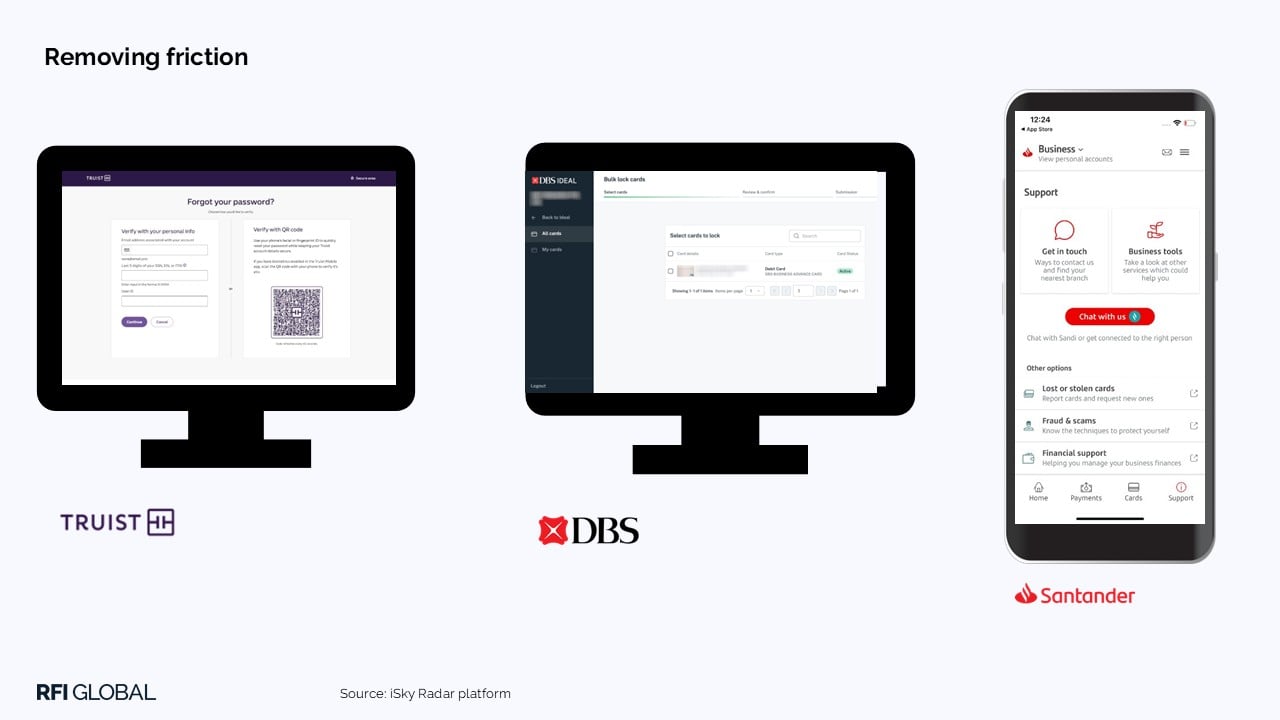
The first test of any digital relationship is access. Providers are expanding login and recovery options while preserving security. Novo uses a one-time email password, while NatWest lets customers choose between app authorisation and a card reader. Truist supports password recovery with a QR code, moving customers more smoothly between desktop and mobile.
The same principle applies once a customer is inside. Bank of America allows users to ask Siri for their balance. Revolut provides detailed transaction filters, Truist enables searches across 24 months, and Westpac makes transaction reporting available.
Card servicing is also becoming more transparent. Chase offers a card tracker, DBS supports bulk card management, and Santander has consolidated card functions into a dedicated tab. Better navigation and status visibility can reduce uncertainty and avoid unnecessary service calls, especially important for businesses managing multiple cards and employees.
2. Make security visible and actionable
Security remains fundamental, but the best experiences do more than add authentication steps. They explain risk, provide useful controls and help customers act confidently.
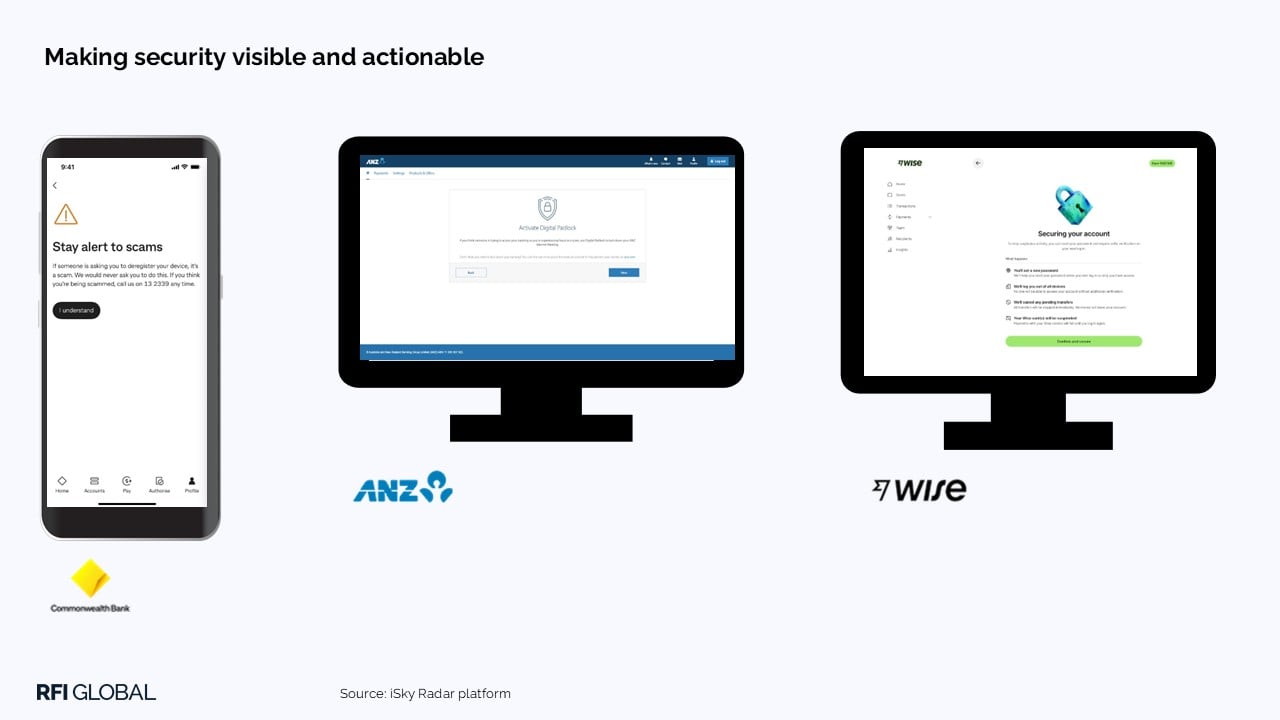
Commonwealth Bank’s registered-device warnings and screen-sharing controls address scams at moments when customers may be vulnerable. Its call-status and fraud links also help customers distinguish genuine contact from suspicious activity. ANZ’s digital padlock, Truist’s fraud-management tools and Wise’s ‘secure your account’ journey similarly turn security from a background promise into something customers can see and manage.
Wise, for example, brings together actions such as logging out of all devices, resetting a password and completing selfie verification, while explaining the consequences for pending transfers. SumUp’s approach to strong customer authentication and device linking also demonstrates the value of making protective steps understandable.
This matters because excessive friction can encourage workarounds, while invisible security can leave customers uncertain. The opportunity is to design protection as a guided experience: clear about the threat, proportionate in its response and easy to complete.
3. Bring payments and administration together
Commercial customers do not think about banking, payments and administration as separate product categories. They see one operating workflow. Providers are increasingly designing around that reality.
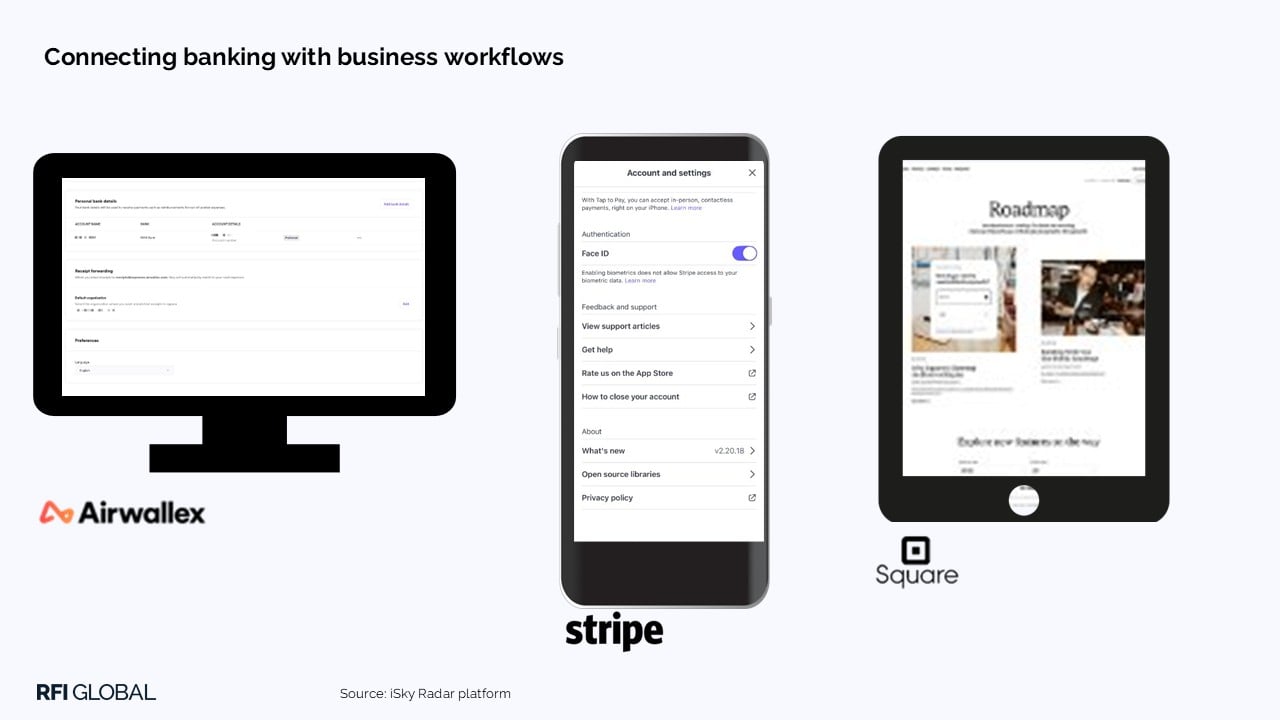
Airwallex illustrates this shift through webhooks and events, which help businesses monitor asynchronous activity and retrigger processes when required. Its AI-assisted receipt matching, receipt-forwarding options and reimbursement workflows reduce manual administration. Expanded developer settings and employment fields further support businesses that need financial tools to connect with internal systems.
Merchant platforms are also simplifying how businesses configure and accept payments. Stripe enables businesses to create payment links, collect relevant customer information and tailor notification preferences. N26’s name-matching feature adds reassurance at the point of transfer, and Westpac’s redesigned payment experience reduces complexity in a frequent task.
Beyond payments, Bluevine, Countingup and Finom are giving invoicing greater prominence, including reusable templates and dedicated navigation. Square is extending its role through point-of-sale hardware, order history, staff time clocks, automated money-movement rules and newer propositions such as Bitcoin conversion and a business credit card.
The strategic message is clear: the more operational work a platform can remove, the more valuable, and harder to replace it becomes.
4. Design digital service to intelligent guidance
Artificial intelligence is beginning to influence both service delivery and financial management. Commonwealth Bank’s CommBiz AI experience shows how conversational assistance can sit within commercial banking, supported by appropriate disclaimers. Airwallex applies AI to practical administrative work, while SumUp uses AI-generated summaries to help merchants understand customer reviews.
Other providers are broadening the insight available to businesses. HSBC’s carbon insights connect financial activity with sustainability considerations. CIBC makes sending limits more visible, helping customers plan before they encounter a restriction. Square openly communicates its product roadmap and invites feedback, making customers participants in the evolution of the platform.
These examples point to a more proactive model. Rather than waiting for customers to find a function or contact support, digital platforms can surface relevant information, explain options and recommend the next action. The challenge will be maintaining trust: intelligent guidance needs to be transparent, accurate and easy for customers to override.
Learn from the leaders
The highest-performing digital experiences share consistent characteristics. They prioritise clarity over feature volume, reduce unnecessary decisions and make complex processes feel manageable.
Our latest iSky Radar Voice of the Customer results reinforce the importance of execution across the complete journey. Revolut leads the global iPhone and desktop web rankings, winning RFI Global awards for best business iPhone app in our UK and Australian Financial Service Awards in 2026. Westpac in Australia also performs strongly. Their performances suggest that digital leadership is not created by one headline feature. It comes from consistent attention to usability, control and clarity across channels.
For commercial banking and merchant service providers, the next competitive frontier is therefore not simply adding more functionality. It is connecting functionality into a coherent experience. Customers want secure access without unnecessary obstacles, powerful controls without confusing navigation, and intelligent support without losing agency.
The providers that succeed will be those that make the complexity of running a business feel lighter. In commercial financial services, simplicity is no longer the absence of capability. It is evidence that capability has been designed well.
Get in touch to explore how iSky Radar can help you benchmark digital experiences, identify opportunities for improvement and understand digital experience trends across commercial banking and merchant services.

Mark Donohue
Managing Director iSky, Global
Mark Donohue is Managing Director of iSky at RFI Global, working with clients globally on data-led financial services intelligence.
View full profileFrequently Asked Questions about commercial banking
Q: What are the biggest digital trends in commercial banking?
Leading commercial banking providers are simplifying sophisticated services by focusing on four design principles: frictionless access, visible and actionable security, connected business workflows and intelligent guidance. Rather than adding functionality for its own sake, the strongest platforms reduce complexity while giving businesses greater control.
Q: How can banks improve the digital experience for business customers?
The strongest commercial banking experiences reduce friction throughout the customer journey. This includes simplifying login and recovery, making security controls easier to understand, integrating payments and administration into business workflows and providing intelligent guidance that helps customers complete tasks quickly and confidently.
Q: How are leading commercial banking providers using AI?
AI is increasingly being used to improve service delivery and financial management rather than simply automate support. Leading providers are applying AI to administrative tasks, surfacing relevant insights and guiding customers through complex processes, while ensuring recommendations remain transparent and easy to override.
Q: What differentiates the best commercial banking platforms?
The highest-performing platforms consistently prioritise usability, clarity and customer control. Rather than relying on individual features, they deliver connected experiences that make complex business tasks simpler, reduce operational effort and help customers manage their finances more efficiently.
What should banks prioritise when designing digital experiences for businesses?
Commercial banks should prioritise reducing friction, making security visible and actionable, connecting banking with business workflows and using intelligent guidance to support customers. Together, these principles help organisations deliver sophisticated digital capabilities without increasing complexity for business users.
Data-driven insights for financial service leaders
Subscribe to The Banknote, our monthly newsletter delivering expert perspectives and exclusive analysis, powered by 200,000 consumer and 60,000 business interviews each year to help you stay ahead in a fast-changing financial world.
