

Kieran Hines, Director, EMEA & North America
There has been a surge in activity around agentic commerce in the past year, and this is driven by the expectation that once customers have the ability to delegate digital commerce to agents, they will. Agentic commerce has the potential to redefine how customers discover, choose, and pay for products. As AI agents take on more of the purchasing journey, banks need to consider how they remain part of the payment process.
To uncover the real impact of agentic commerce for financial institutions, we asked 4,000 US consumers via our Innovation Monitor study about how they use AI tools to support their shopping activity, and their thoughts about enabling agents to act on their behalf in the future.
Consumers are already making extensive use of AI tools to research and optimize their shopping activity, but the move towards agents acting autonomously will require clear controls and a liability model.
AI is already an important part of the shopping journey for many customers
AI tools are already part of day-to-day life for many US consumers. One in four uses an AI tool for some part of the journey, and commerce is the fourth most common way to use AI (26%). It sits just behind general information and research (49%), work and productivity tasks (30%) and writing or summarizing content (27%).
Looking across the whole commerce lifecycle, the proportion of customers using AI increases to 35%. That’s the proportion of customers that use an AI tool as part of their initial search or thinking about a purchase, and for some that’s where the journey ends.
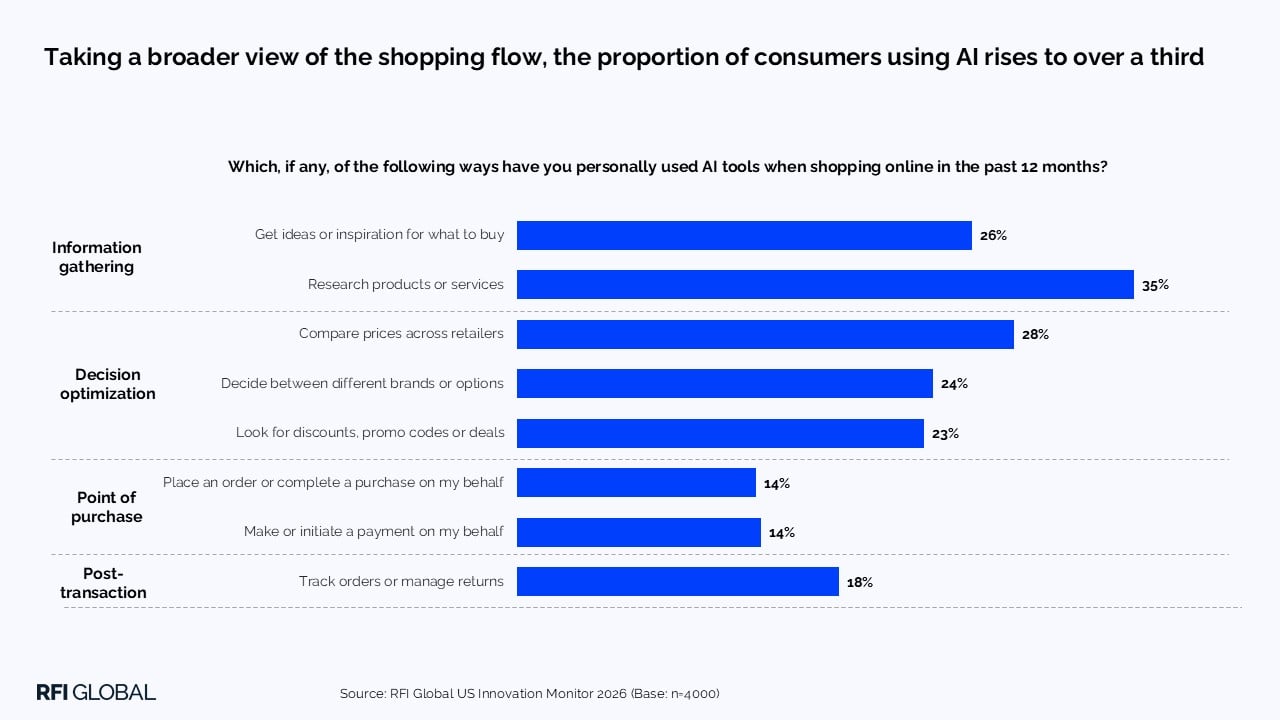
However, the drop-off from information gathering to the next logical step is small. Customers who start with research quickly move to the next stage: ‘where can I get the best deal? Over a quarter (28%) go on to compare prices, then 23% use AI to get support in looking for specific discounts or deals.
Already, as many as 14% of US consumers have used an AI agent to place an order or to initiate a payment on their behalf. This captures a range of activity right up to the point of payment authorization, but the messages for the industry are clear:
- Customers are already using AI tools to support digital commerce.
- One in seven US consumers have already allowed an AI agent to purchase on their behalf – and this number is likely to grow
Customers are open to agentic commerce
What we’ve shown so far is the use of existing customer-facing tools in digital commerce, but agentic commerce is a much more significant concept. Here we’re talking about customers delegating decision-making and payment initiation for a range of potential purchases and transactions to AI agents or tools.
Customers are very open to the idea of agentic commerce. Around three-quarters of US consumers are comfortable with the idea of handing -off product research (74%), comparing prices (77%) and looking for discounts (74%).
And when it comes to locking in those purchase decisions and triggering a payment, half the population would consider letting an agent place an order.
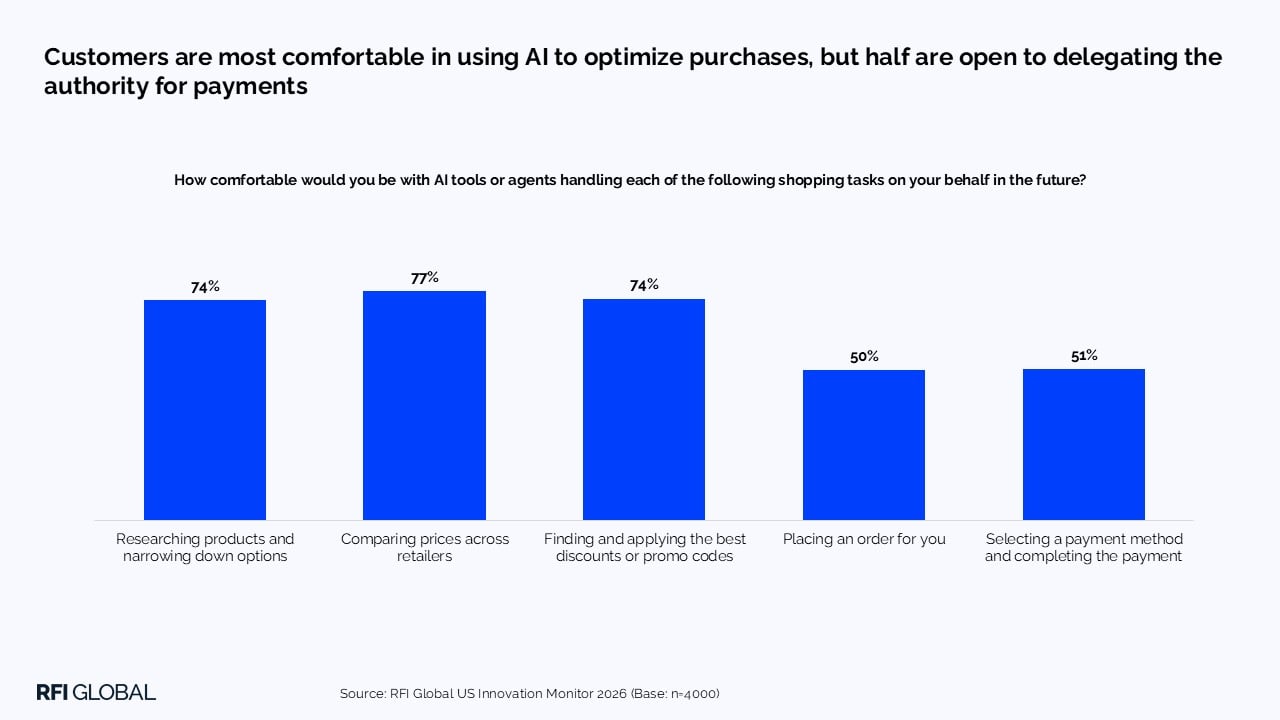
However, the gap between background research and actually placing an order may just be a case of familiarity. Among those who already use AI for digital commerce, the proportion comfortable with delegating payments to an agent rises to 70%.
Delivering on trust, through controls and a clear liability framework is key to driving future adoption
The appetite for agentic commerce is undeniable, but the industry needs to ensure customers have full trust in the model. There are two areas financial institutions need to address to scale this interest into activity.
The first is to build in adequate controls for customers around payment, and the second is clarity over what happens when things go wrong. When it comes to control, the message is loud and clear. Only 21% are happy for agents to act fully autonomously in all cases, and this falls to 7% among those who already use AI for shopping. Clearly, the more customers use AI, the more aware they are that it is fallible. This does not mean that customers expect to approve every agentic AI payment either, and only 23% would expect this capability.
Our data show that the notion of control falls into two areas. The first is protection against bad decisions through context-specific guardrails. For purchases above a given value or those involving the potential to purchase add-on or upgraded services, 19% would want to approve before the payment. A similar proportion want decision authority when an agent is deciding between several similar options.
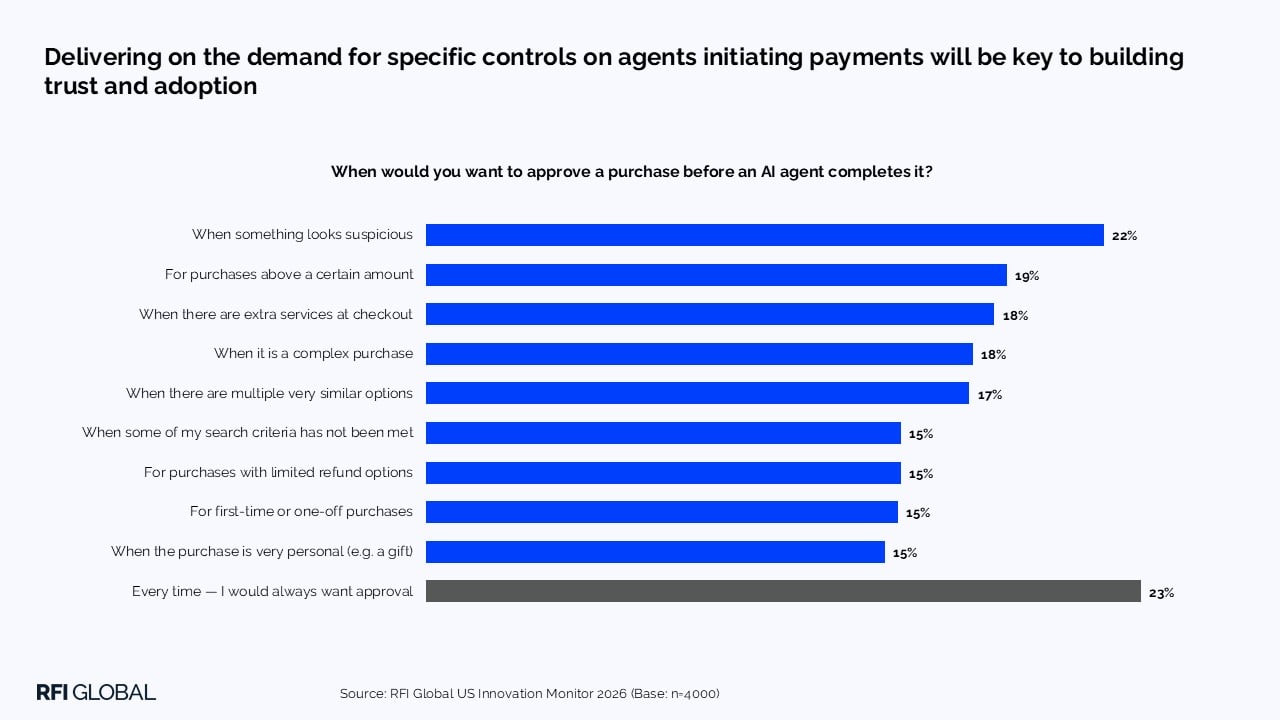
Customers also expect protection from their payment provider. For 22%, the ability to approve a transaction is expected when the transaction looks suspicious, and this increases to almost 30% among those who already use AI to support their shopping activities. In other words, the group most likely to be the early adopters of agentic commerce are the clearest about the need for effective safeguards against errors.
Liability is the other area that financial institutions need to address. Customers seem unclear on what to do if an agentic purchase goes wrong, with 38% noting that it would depend on the situation and around one in five would respectively see the responsibility as theirs, the bank/issuer, or – most interestingly – the company behind the agent itself.
While this is a nascent space, agentic commerce is a development of the existing digital commerce framework, and consumers will come to expect the same protections as they enjoy today if the industry sees adoption.
Addressing control and liability are fundamental building blocks in the future value chain.
Capturing the opportunities agentic commerce brings
Customers are already using AI in digital commerce, and many are comfortable with having AI agents act with (some) autonomy. Banks should accelerate their plans to support customers with the payment tools to enable agents to transact on their behalf, or risk losing these payment flows to providers that can deliver.
As with any type of payment or commerce model, adoption will be built on trust. The payment networks and others building the technology to enable agentic commerce should not neglect the importance of building granular and context-specific controls, bearing in mind that the ability to customise these will be critical. The industry must also set out unambiguously who carries the liability when agents get it wrong.
Get in touch for further insights from Innovation Monitor.

Kieran Hines
Director, EMEA & North America
Kieran Hines is Director at RFI Global, leading research and advisory work across EMEA and North America. He is a senior financial services analyst with deep expertise in retail and business banking, payments and digital transformation.
View full profileFrequently asked questions about agentic commerce in banking
Q: How many US consumers have used AI agents to make payments?
RFI Global’s US Innovation Monitor study found that 14% of US consumers have used an AI agent to place an order or initiate a payment on their behalf. The activity measured extends up to the point of payment authorisation.
Q: Are consumers ready to let AI agents make purchases on their behalf?
Half of US consumers would consider allowing an AI agent to place an order on their behalf. Consumers are even more comfortable using AI earlier in the journey, including for product research, price comparison and finding discounts.
Q: What payment controls do consumers expect from banks and payment providers?
Consumers favour controls that reflect the context of the transaction. Some want to approve higher-value purchases, add-ons or upgrades, choices between similar products, and transactions that appear suspicious. Only 21% are comfortable with agents acting fully autonomously in every situation.
Q: Who is liable when an AI agent makes a payment or purchasing mistake?
Consumers are currently unclear about where responsibility should sit when an agentic purchase goes wrong. While 38% say it would depend on the situation, around one in five respectively attribute responsibility to themselves, the bank or issuer, or the company behind the AI agent.
Q. What do banks need to do to support wider adoption of agentic payments?
Banks need to provide clear, context-specific payment controls and help establish an unambiguous liability model for agent-led transactions. Customers also expect protection when transactions look suspicious. Addressing control, protection and responsibility will be important to building trust in agentic commerce.
Data-driven insights for financial service leaders
Subscribe to The Banknote, our monthly newsletter delivering expert perspectives and exclusive analysis, powered by 200,000 consumer and 60,000 business interviews each year to help you stay ahead in a fast-changing financial world.
