

Jackie Greig, VP Marketing, Global
How consumer behaviour is evolving across five key industry trends
Since the start of 2025, the financial services landscape has been marked by unprecedented change, driven by global economic volatility, shifting interest rates, geopolitical tensions and the ongoing ripple effects of tariff uncertainty. These forces are not only disrupting markets but also reshaping how consumers and businesses think about money, savings, loyalty and the providers they choose to trust.
As their influence grows, understanding Gen Z’s behaviour and attitudes, how they bank, pay, discover and switch, is critical to building relevance, trust and long-term growth.
At the end of 2024, we analysed data from over 200,000 consumers and 60,000 businesses globally to identify the key trends set to define financial services in 2025 for our Financial Services Trends and Predictions report.
In this mid-year review, our global experts revisit these trends to explore how they are evolving, where new behaviours are emerging, and what financial institutions must do to stay ahead. While some themes, such as the growing dominance of mobile, the rise of fintechs and neobanks, and the demand for greater personalisation, consumer responses are far from uniform across markets.
Our latest data highlights key differences across the US, UK, Australia and APAC, from switching behaviour and savings habits to digital adoption and attitudes towards AI and reveals which markets are leading or lagging when it comes to adopting new behaviours and embracing innovation.
In this short video, Charles Green, RFI Global’s co-founder, shares an overview of the major forces reshaping the industry and introduces the shifts in consumer behaviour we explore below and in our bite-sized videos.
Five trends shaping the financial services industry – update
1. Winning loyalty in a world of change: customer retention in turbulent times
In a climate of high cost-of-living pressures, shifting rates and growing digital competition, traditional loyalty is under pressure. Consumers are seeking more control over their financial relationships – pursuing better rates, personalised rewards and providers that deliver clear value.
But while loyalty is being tested, switching intent still varies by market. In Australia, transaction account switching remains stable at 9%, with many consumers waiting to see what happens next. In the US, 26% say they would switch for better rewards, signalling the growing influence of loyalty incentives.
In the UK, challenger banks like Monzo and Chase continue to grow, fuelled by consumer demand for better offers. But rewards alone aren’t enough. To earn lasting loyalty, programmes must be transparent, personalised and deliver value.
CommBank’s Yello programme in Australia shows how well-targeted rewards and clear communication can drive engagement and perception at scale.
As expectations rise, financial institutions must evolve. Loyalty must now be earned through relevance, recognition and real value.
2. The digital edge: fintech, AI and the future of financial services
Digital continues to reshape financial services at an unprecedented pace, from challenger banks to mobile-first experiences and emerging AI tools. In the US, 31% of new primary bank accounts opened in the past 24 months were with a challenger bank, up from 18% two years ago. Mobile banking is now used by 78% of households, and mobile investing is rapidly catching up with desktop usage.
AI is also rising up the agenda. While consumer-facing AI tools are still relatively limited, financial institutions are investing heavily in back-end applications, especially in fraud detection and risk assessment. For mass adoption, though, trust will be key.
RFI Global data shows that in the US, consumers are most comfortable with AI chatbots and least comfortable with robo-advisors. One in four households is already engaging with AI in some form, but concerns around data security, privacy and accuracy persist.
Clear communication and transparency around how AI is used will be critical in building trust and confidence.
3. Navigating market volatility: the impact of rate shifts on consumer saving and borrowing
As central banks around the world have cut interest rates, there has been a marked change in consumer behaviour, in the way they save and borrow, and their intentions to switch.
In the UK, 44% of consumers now say they plan to switch their savings account, up from 20% at the end of 2022. Typical monthly savings have increased by around 40%, and 29% plan to save more in the next 12 months. Across APAC, similar patterns are emerging, with around half of consumers in Indonesia and Malaysia, and a third in Hong Kong, planning to save more over the next 12 months.
In Australia, savers are more rate-driven. 59% of savers now hold multiple savings accounts, and 48% of recent switchers say they did so to access a better rate.
This trend shows no signs of slowing. As rates continue to shift, consumers will keep reassessing their financial products and providers.
For banks and financial institutions, that means delivering more than competitive pricing, offering flexibility, simplicity, and a clear sense of value will be critical to both retention and growth.
4. The wealth advantage: the rise of the emerging affluent
Emerging affluent consumers are fast becoming one of the most influential segments in global finance. This group is digitally savvy, financially ambitious, and often more focused on sustainable investments, global diversification and long-term financial security.
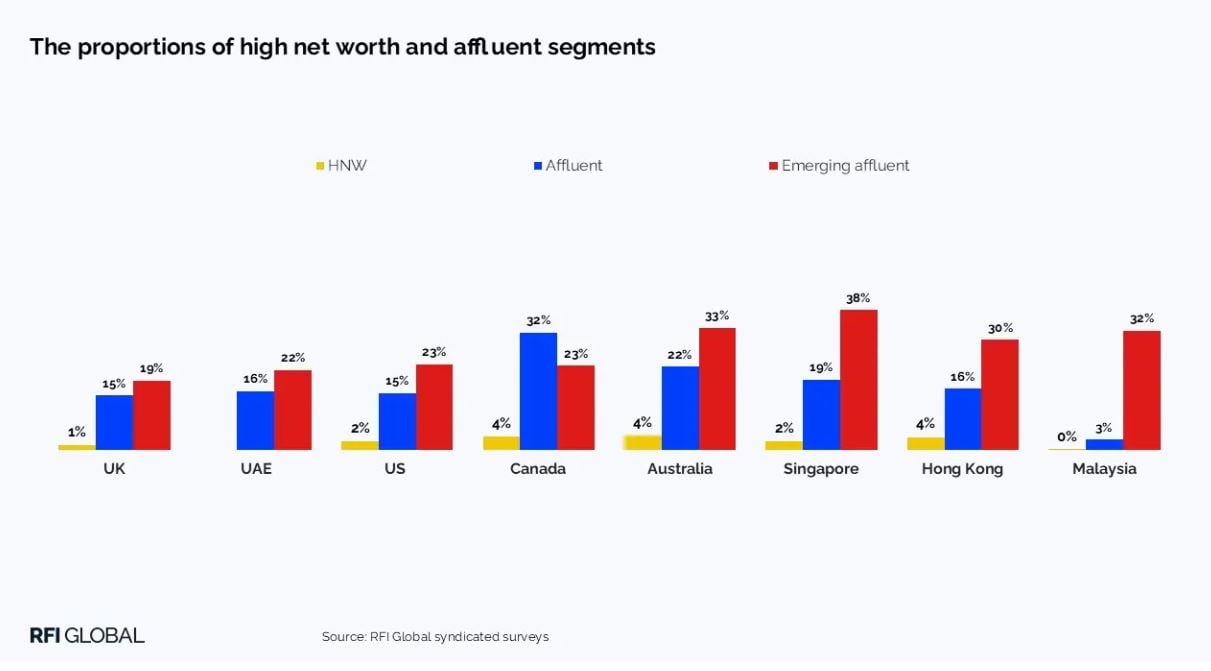
In APAC, this trend is particularly pronounced. Emerging affluents now account for 38% of the population in Singapore, 30% in Hong Kong and 32% in Malaysia. In the US and UK, the segment represents 23% and 19% respectively.
What’s notable is that these customers tend to consolidate their financial relationships early in their wealth journey and are more willing to switch providers if expectations are not met. It’s also at this stage that we see a shift from local banks to international players such as HSBC, Standard Chartered, and Citi, who are making gains by offering competitive products, personalised engagement, and global reach.
Capturing this segment early will lead to long-term, high-value relationships. To stay competitive, financial institutions must focus on tailored engagement strategies, differentiated offerings and loyalty programmes that reflect the emerging affluent’s evolving needs and priorities.
5. Unlocking cross-border payments: driving growth and customer acquisition
Cross-border payments underpin global trade, yet for many small and mid-sized businesses (SMEs and MMEs), these services still fall short. One in four businesses worldwide plans to grow internationally, but pain points like FX risk, poor visibility and lengthy processing times remain, and new challenges like tariff uncertainty are emerging.
In Malaysia and Hong Kong, four in ten businesses cite FX risk and supply chain management as their top cross-border challenges, ranking them ahead of concerns like cash flow or revenue growth. In Canada, one in five businesses plan to shift supply chains or trading partners in the next year, while in the UK, the same proportion are focusing more on local or regional trade. Ecommerce is also emerging as the primary tool for cross-border growth, and digital solutions are becoming ever more important.
For financial institutions, this signals a clear opportunity: those that offer faster, more transparent and more affordable solutions can not only support business growth but build stronger loyalty in the process.
What next?
Staying ahead in financial services means staying informed. Our experts have unpacked our latest data on the five shifts shaping the industry in 2025. Watch the short videos to explore the latest insights in just a couple of minutes each and get in touch if you’d like to learn more about what it means for your market.
Discover the trends that are shaping financial services in 2025.

Jackie Greig
VP Marketing, Global
Jackie Greig is the Global VP of Marketing at RFI Global. She is a senior marketing and market research leader with extensive experience building global marketing strategies for financial services brands.
View full profileFrequently Asked Questions
1: What are the biggest financial services trends in 2025?
A: RFI Global’s mid-year analysis reviews the five key trends we identified at the end of 2024 that are shaping the industry: shifting consumer loyalty, the rapid rise of fintechs and neobanks, changing saving and borrowing behaviour due to rate cuts, the growing influence of the emerging affluent, and the need to improve cross-border payment services for businesses.
2: How is consumer behaviour changing in financial services?
A: Our data from over 200,000 consumers and 60,000 businesses shows major changes in switching behaviour, savings habits and digital adoption. For example, in the UK, 44% of consumers plan to switch their savings account, while in the US, mobile banking use has reached 78% of households.
3: Which markets are leading or lagging in adopting new financial behaviours?
A: The US shows strong growth in challenger bank usage and high mobile banking adoption. APAC leads with the largest emerging affluent populations. The UK is seeing rapid changes in savings behaviour and Australia remains steady on transaction switching, while savings competition intensifies.
4: Why should financial institutions track these trends?
A: Understanding these shifts enables banks and providers to adapt their strategies for customer acquisition, retention and product innovation. With behaviours varying significantly by market, staying informed is essential to remain competitive and deliver value to both retail and business customers.
Data-driven insights for financial service leaders
Subscribe to The Banknote, our monthly newsletter delivering expert perspectives and exclusive analysis, powered by 200,000 consumer and 60,000 business interviews each year to help you stay ahead in a fast-changing financial world.
