

Caitlin Hill, Insights Director, Australia
Australia’s card payments market is about to undergo one of its most significant changes in years. Following the Reserve Bank of Australia’s announcement, surcharges for credit and debit cards will be removed from 1 October 2026, alongside changes designed to reduce card acceptance costs for businesses.
While the ban on card surcharges has dominated headlines, the broader reforms will have implications for how businesses manage payment costs, use cards and evaluate their payment providers. For banks and payment providers, the opportunity lies in helping businesses navigate this transition and maintain confidence in card payments.
Drawing on insights from more than 850 Australian businesses, we explored how businesses view the changes, how they expect to respond and what they will need from banks and payment providers as the reforms take effect.
How businesses feel about the surcharge changes
Businesses already see card acceptance as costly, with almost two-thirds (63%) believing acceptance costs are too high and half saying surcharges are the main factor discouraging card use.
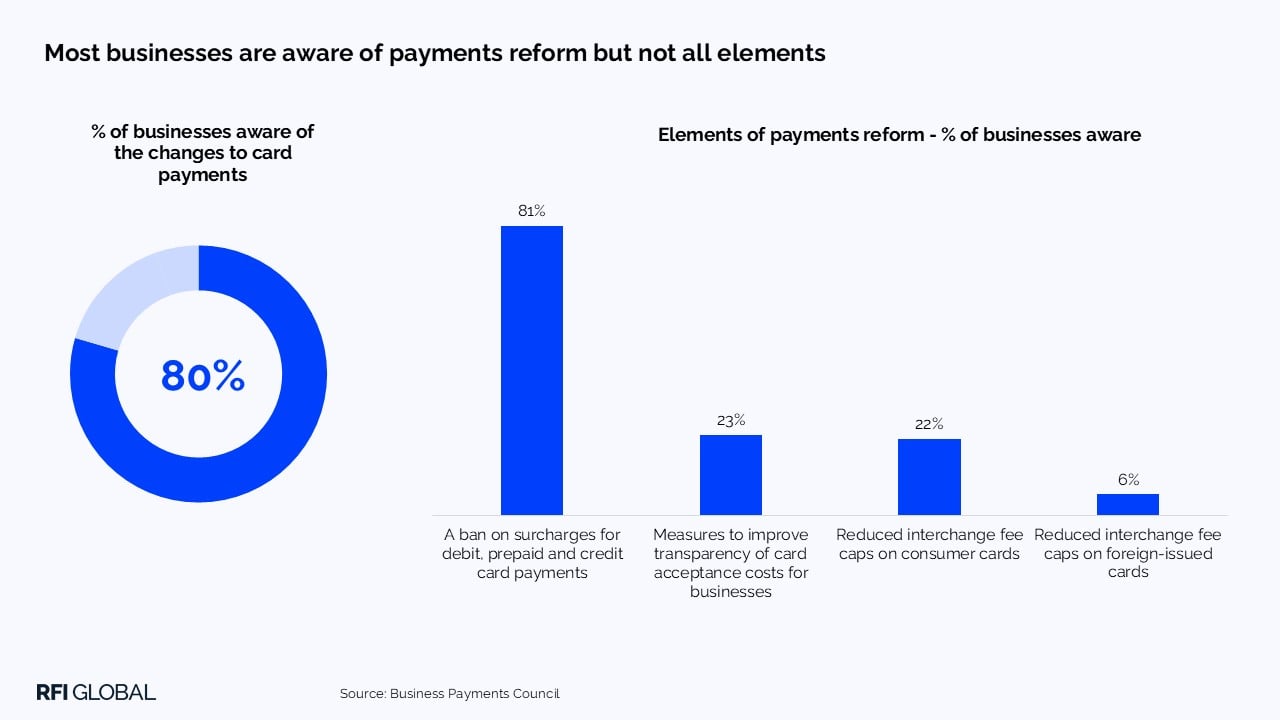
The imminent changes will fundamentally change how businesses recover payment acceptance costs, but the surcharge ban is only part of the reform. While most businesses are aware that surcharging is ending, awareness of the wider changes remains limited. More than eight in ten (81%) know the ban is coming, but only around a quarter are aware of measures to improve transparency around card acceptance costs or reduce interchange fee caps on consumer cards, and only 6% are aware of changes to foreign-issued card fees.
Businesses largely believe the reform will be good for consumers (62%), followed by the Australian economy (37%). However, sentiment is notably more cautious when it comes to the impact on their own business. Just 21% believe the reforms will have a positive impact on their business, while 28% believe they will benefit businesses in general. This suggests many businesses recognise the broader intent of the reforms but remain uncertain about what they will mean for their own costs and payment strategies in practice.
Most businesses will maintain or increase card usage
Despite the changes, card usage is unlikely to decline. Half of businesses using business cards (51%) and 40% of those using personal cards for business expenses expect to use cards more once the reforms take effect.
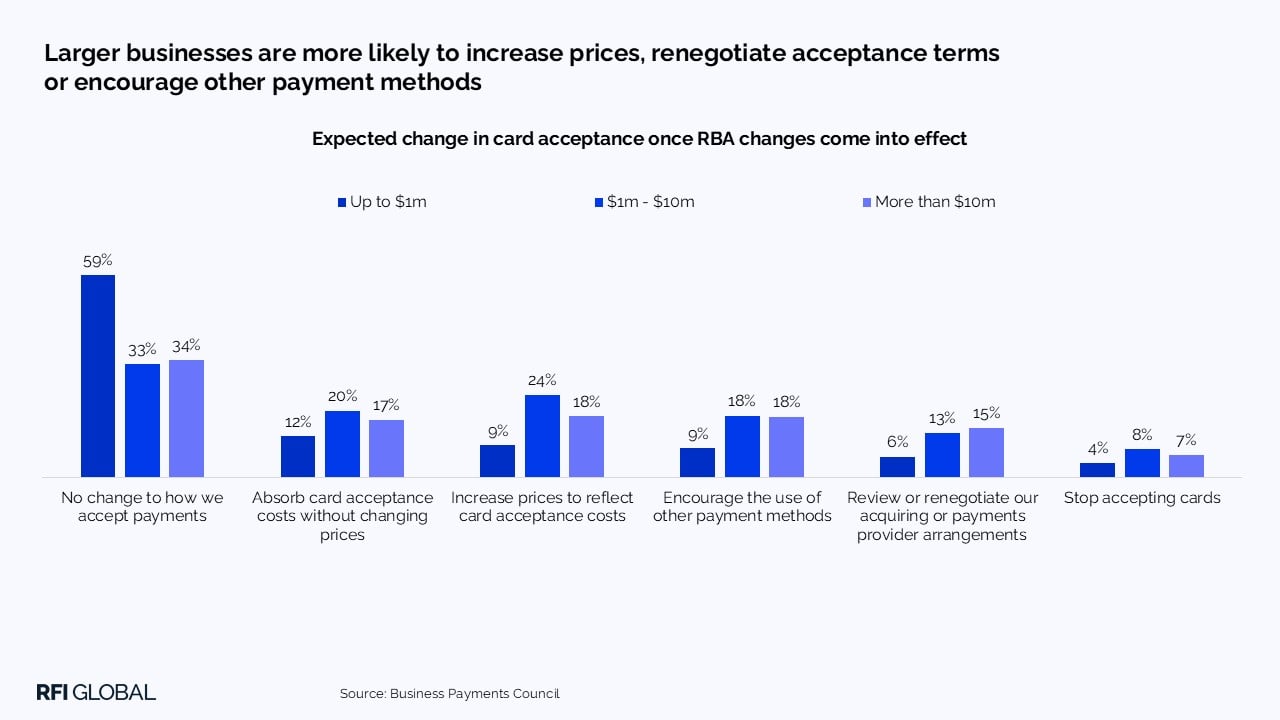
When it comes to card acceptance, the expected response varies by business size. Larger businesses (turnover above $1 million) are more likely to increase prices to offset card acceptance costs, encourage the use of alternative payment methods or renegotiate their acceptance arrangements. By comparison, small businesses expect little change, with 59% saying they don’t plan to alter how they accept payments.
Our findings suggest that rather than reducing card acceptance, businesses are adapting how they manage payments. For acquiring banks and payment providers, this reinforces the importance of helping businesses optimise payment economics rather than simply driving card adoption.
Businesses remain sensitive to fees and rewards
Changes to fees or rewards could have a far greater impact on card usage than the surcharge reforms themselves. The response differs depending on whether businesses use personal or business cards for business expenses.
If fees increase or rewards are reduced, nearly half of businesses using business cards (47%) say they would reduce card usage and switch to alternative payment methods such as BPAY. Businesses using personal cards are less certain about how they would respond, with almost one in five (18%) saying they are unsure.
Our data suggests that businesses remain committed to card payments, but not at any cost. As providers adapt their pricing and rewards strategies in response to the reforms, maintaining a compelling value proposition will be critical to retaining card spend.
How can banks and payment providers support businesses through the transition?
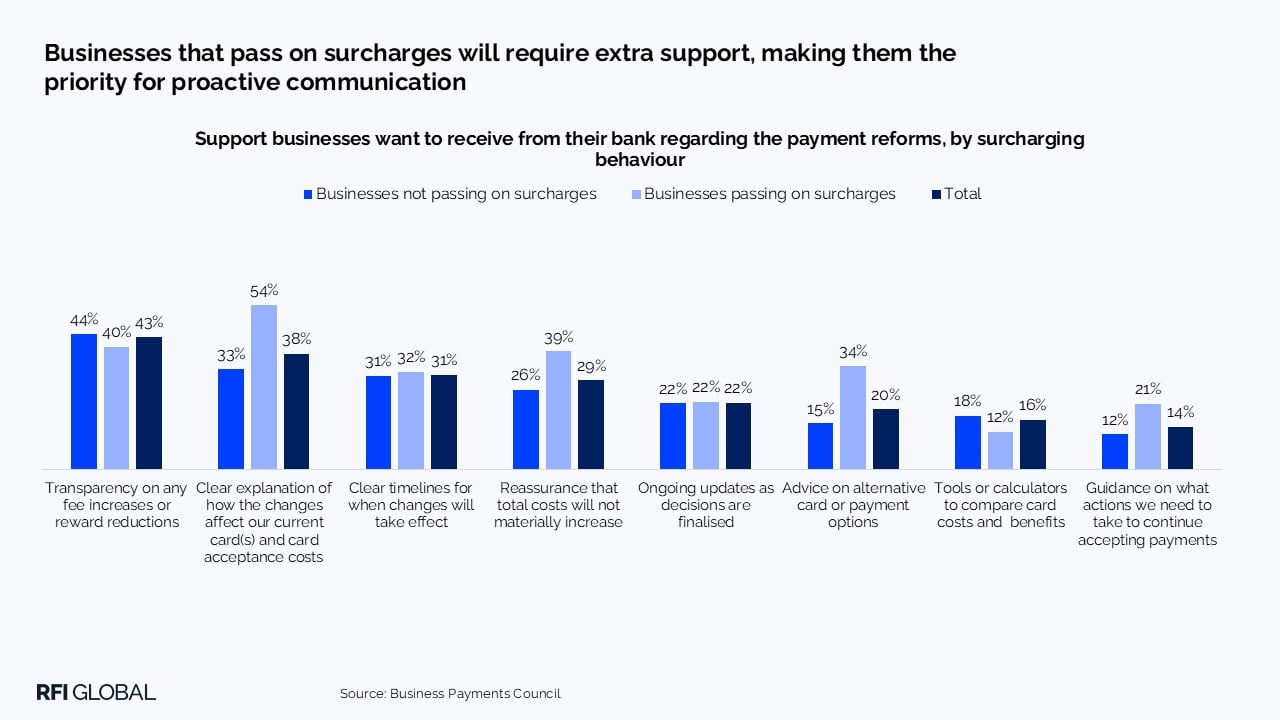
The reforms also create an opportunity for banks to support business customers through the period of change. Businesses are looking for transparency around any fee increases or reward reductions, alongside clear communication about how the reforms will affect their card acceptance costs. Clarity on timelines, reassurance that costs will not increase materially and ongoing updates are all important considerations
Businesses that currently pass on surcharges appear to feel most exposed by the changes and require the greatest level of support. More than half (54%) want clear explanations of how the reforms will affect their business, while 39% are looking for reassurance that costs will not increase significantly.
For banks and payment providers, effective communication may prove just as important as the reforms themselves. Businesses that understand how the changes affect their costs and payment options are likely to be better placed to adapt, making proactive communication a key differentiator in the months ahead.
What this means for banks and payment providers
The removal of card surcharges marks an important shift in Australia’s payments landscape, but it is unlikely to fundamentally change businesses’ reliance on cards. Instead, it is changing how businesses think about payment costs, provider relationships and the value they receive from card-based payments.
For banks and payment providers, success will depend not just on responding to the reforms, but on helping businesses respond to them. Institutions that communicate clearly, provide practical guidance and demonstrate ongoing value will be best placed to strengthen customer relationships and retain payment volumes in the years ahead.
As payment reforms approach, understanding how businesses are responding will be critical. Get in touch for further guidance from RFI Global’s Business Payments Council.

Caitlin Hill
Insights Director, Australia
Caitlin Hill is an Insights Director at RFI Global, leading financial services research across Australia.
View full profileFrequently Asked Questions
Q: What impact will Australia's surcharge ban have on business payment behaviour?
RFI Global’s research suggests the removal of card surcharges is unlikely to significantly reduce business card usage. Around half of businesses using business cards expect to use cards more once the reforms take effect. Instead of moving away from cards, many businesses are expected to focus on managing payment costs and reviewing their payment acceptance strategies.
Q: How are Australian businesses preparing for the 2026 card payment reforms?
Most businesses expect to maintain their current approach to payment acceptance, although larger businesses are more likely to review pricing, renegotiate acceptance arrangements or encourage alternative payment methods. The findings suggest the reforms will drive greater scrutiny of payment economics rather than a widespread shift away from card payments.
Q: What are Australian businesses most concerned about following the surcharge ban?
Businesses remain highly sensitive to payment costs. While they understand the intent of the reforms, many are uncertain about how the changes will affect their own business. Research indicates that increases in card fees or reductions in rewards could have a greater impact on card usage than the surcharge ban itself, particularly among businesses that rely on business credit cards.
Q: What support do Australian businesses want from banks and payment providers ahead of the card surcharge ban?
Australian businesses are looking for clear communication about how the payment reforms will affect card acceptance costs, transparency around any fee or rewards changes, reassurance that costs will not increase significantly and regular updates as the reforms approach. Businesses that currently pass on surcharges are particularly seeking guidance on how the changes will affect their business.
Data-driven insights for financial service leaders
Subscribe to The Banknote, our monthly newsletter delivering expert perspectives and exclusive analysis, powered by 200,000 consumer and 60,000 business interviews each year to help you stay ahead in a fast-changing financial world.
