

Jackie Greig, VP Marketing, Global
US consumers are reshaping how they bank, invest, and seek financial advice—and the pace of change is accelerating.
RFI Global’s latest insights, based on data from over 5,000 US households, highlight five consumer trends that will influence financial services strategy in 2026.
Mobile-first finance and the growing influence of social media are reshaping financial services. There is also renewed demand for expert guidance and changing investment preferences. Building trust in AI also remains a key challenge. The message is clear: customer expectations are rising, and competition from fintechs is fiercer than ever.
Whether you’re refining your digital roadmap, rethinking how you deliver advice, or seeking new ways to connect with consumers, these trends give you a clear view of what US households want—and the insights you need to shape a strategy that resonates in 2026.
Five consumer trends that will influence financial service strategy in 2026
1. Social media: The new frontline of financial influence
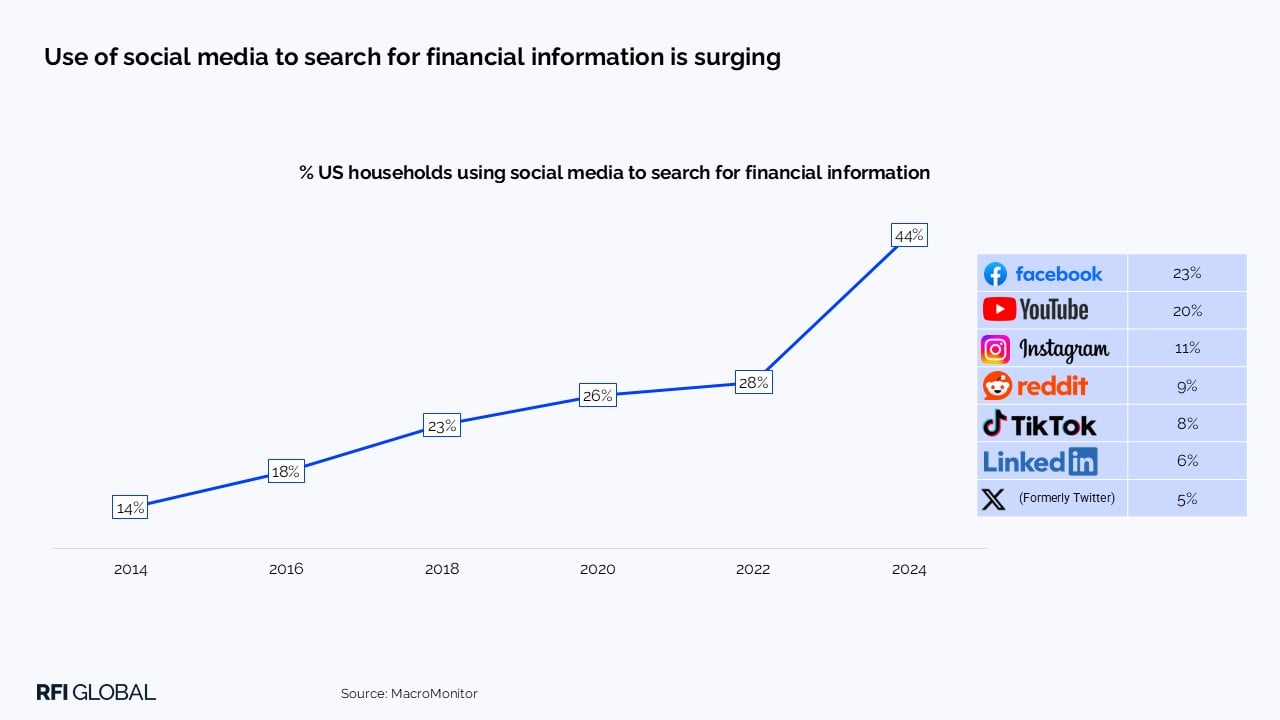
Social media has moved beyond brand awareness for financial services—it’s now a driver of consumer decision-making. In just two years, the proportion of US households using social platforms for financial information has surged from 28% to 44%.
Facebook leads the pack, with YouTube close behind. Among younger generations, usage is even higher: 54–56% of Gen Z and Millennial households use at least one platform to research or share financial content. In addition to Facebook and YouTube, they are also more likely to turn to Reddit and TikTok.
These channels are increasingly trusted for guidance, shaping everything from product discovery to provider choice. Content that’s educational, peer-endorsed, or delivered by a brand with an authentic voice stands out most.
To win consumers’ attention and trust, financial institutions must treat social media as a core engagement channel—delivering credible, useful content that sparks conversations and influences real financial decisions.
2. Mutual funds on the rise: Capture the growing appetite
Investor priorities are shifting. While crypto remains a niche holding for most households, mutual funds are seeing renewed momentum, driven by growing caution around bonds. Today, 41% of US consumers express concerns about bonds, up from 33% in 2022.
Nearly 1 in 5 households now plan to invest in mutual funds—and half will be first-time buyers. Existing investors are also committing more, with average balances increasing by nearly $90K in just two years. In an era of economic uncertainty, households are favoring products that offer diversification, stability, and long-term growth without excessive risk.
This shifting behaviour presents a major opportunity for financial institutions to educate, engage, and convert new investors, especially through intuitive, digital-first platforms. Those that adapt quickly will attract new customers and increase loyalty amongst existing customers.
3. Mobile-first finance: The app is the anchor
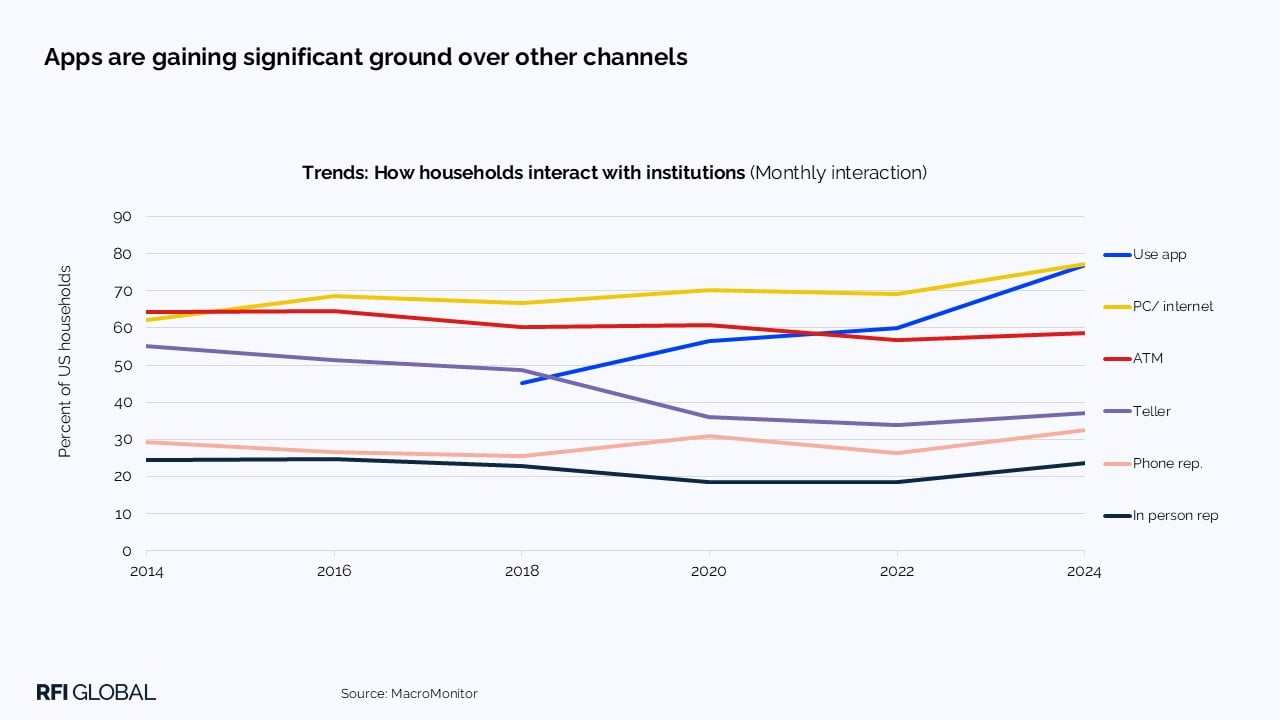
Mobile has overtaken desktop as the leading channel for online banking and is set to become the #1 channel for investing early in 2026. 77% of US households engage with their financial institutions via mobile apps each month, making mobile the most-used channel, surpassing desktop, branches, and call centers.
Consumers no longer just check balances on the go—they expect real-time updates, intuitive design, and seamless onboarding. Institutions that meet these expectations will be rewarded with loyalty and new business.
Challenger banks and fintechs have led the charge. They offer streamlined, user-friendly experiences that feel less like managing finances and more like managing a playlist—intuitive, personal, and always accessible.
Over the past two years, 31% of new primary banking relationships were opened with challengers like Chime and SoFi. In investing, 19% of new relationships are with fintech platforms like SoFi and Robinhood.
In 2026, mobile will be the main stage. Firms delivering seamless, app-first experiences will be the ones front and center on consumers’ screens—and in their daily routines.
4. Financial advice: From optional to essential
After years of DIY money management, US households are rediscovering the value of expert financial guidance. Today, 56% of households now seek financial advice, up from 40% in 2022, marking the highest demand since the 2008 financial crisis. Debt planning and budgeting support lead the surge, as economic pressures prompt more people to seek reassurance and structure.
Advice itself is under greater scrutiny. Consumers are more selective, price-sensitive, and increasingly focused on the style of communication. More consumers now expect proactive engagement from their financial professionals, especially during uncertain times. This subtle but powerful shift means responsiveness and empathy are as critical as technical expertise.
Advisors must be proactive, personal, and responsive. Financial institutions that combine empathetic human insight with advanced technology—such as AI-assisted tools—will build deeper, longer-lasting client relationships.
In a market where trust and connection matter more than ever, firms blending high-tech solutions with a personal touch will be best positioned to meet rising expectations and cultivate loyalty over time.
5. AI in finance: Time to move from hype to habit
AI is reshaping everything from customer service to investment advice, but consumer trust hasn’t kept pace. 84% of households still have concerns about AI in financial services, especially around data security, accuracy, and fairness. Consumers want confidence that their information is protected and that AI decisions are transparent and unbiased.
Trust varies by tool: 23% feel comfortable using AI for chat-based support and fraud prevention, but only 8% are comfortable with fully automated robo-advisors.
However, openness is growing—particularly among younger generations, who are more comfortable with chatbots, fraud detection, and AI-powered support. In 2022, nearly a third of households said they were unlikely to try new financial services without a personal recommendation; today, that’s dropped to 19%, reflecting rising tech confidence.
In 2026, success with AI will hinge on transparency, fairness, and a human-first approach—trust, not speed, will be the true differentiator.
Stay ahead in a rapidly changing financial landscape
2026 is poised to be one of the most competitive and transformative years in US financial services. The five trends highlighted here shine a light on key shifts—but there’s much more to uncover.
Powered by data from over 5,000 US households, our MacroMonitor survey is the most comprehensive study of consumer financial behavior. With over 40 years of continuous insight, it offers a 360-degree view of consumer needs, aspirations, product usage, provider preferences, and the competitive forces shaping the market.
Download the full, complimentary booklet and get in touch to explore how our data can fuel your 2026 strategy and help you seize emerging opportunities.

Jackie Greig
VP Marketing, Global
Jackie Greig is the Global VP of Marketing at RFI Global. She is a senior marketing and market research leader with extensive experience building global marketing strategies for financial services brands.
View full profileFrequently Asked Questions
Q: What consumer insights do financial institutions need for 2026 planning?
A: This article highlights five critical consumer insights for 2026 planning: growing mobile app usage, the expanding role of social media in financial decisions, increased demand for personalized financial advice, shifting investment preferences toward mutual funds, and consumer trust challenges with AI-powered services.
Q: How are US consumers' behaviors changing in banking and investing?
A: US consumers are increasingly mobile-first, with 77% using mobile apps monthly. They seek real-time updates and seamless experiences. Social media is also becoming a trusted source for financial information and peer recommendations, especially among younger generations.
Q: What do US consumers expect from financial advice in 2026?
A: More consumers are valuing expert financial guidance, with 56% seeking advice, up from 40% in 2022. They want advisors to be proactive, empathetic, and to use technology like AI to enhance personalization and responsiveness.
Q: What are the key challenges and opportunities with AI in financial services?
A: While AI adoption grows, 84% of consumers still have trust concerns, mainly about data security and fairness. Financial institutions must focus on transparency, fairness, and combining AI with human interaction to win consumer trust in 2026.
Data-driven insights for financial service leaders
Subscribe to The Banknote, our monthly newsletter delivering expert perspectives and exclusive analysis, powered by 200,000 consumer and 60,000 business interviews each year to help you stay ahead in a fast-changing financial world.
