

Dan Latimore, Head of Research, North America
RFI Global research shows that fraud reaches 61% of US consumers, but banks resolve individual cases without paying enough attention to the overall relationship. 79% of customers affected by fraud, even those who had fraud attempts blocked, have changed how they bank or pay. Fraud protection is the biggest factor in how consumers choose to pay, and clear reimbursement guarantees provide the most confidence.
Reported fraud losses in the US are at a record high. The FTC logged $15.9bn lost by consumers in 2025, up from $12.5bn the year before, and the FBI’s Internet Crime Complaint Center recorded $20.9bn in internet crime losses. Innovation Monitor, our survey of 4,000 US consumers fielded in June 2026, shows that almost two-thirds of US consumers have been exposed to fraud and measures the overall cost for banks.
Here are four key takeaways about fraud from our survey:
1. Most fraud exposure never becomes a case
61% of US consumers have had some exposure to fraud in the past 12 months, and 26% lost money to a scam or had an unauthorized transaction on their account. 12% lost money to a scam outright. Younger consumers are hit hardest. 35% of Gen Z were defrauded or had an account compromised in the last year, against 19% of Boomers. They transact more often, across more providers and platforms, and each one is a new point of exposure.
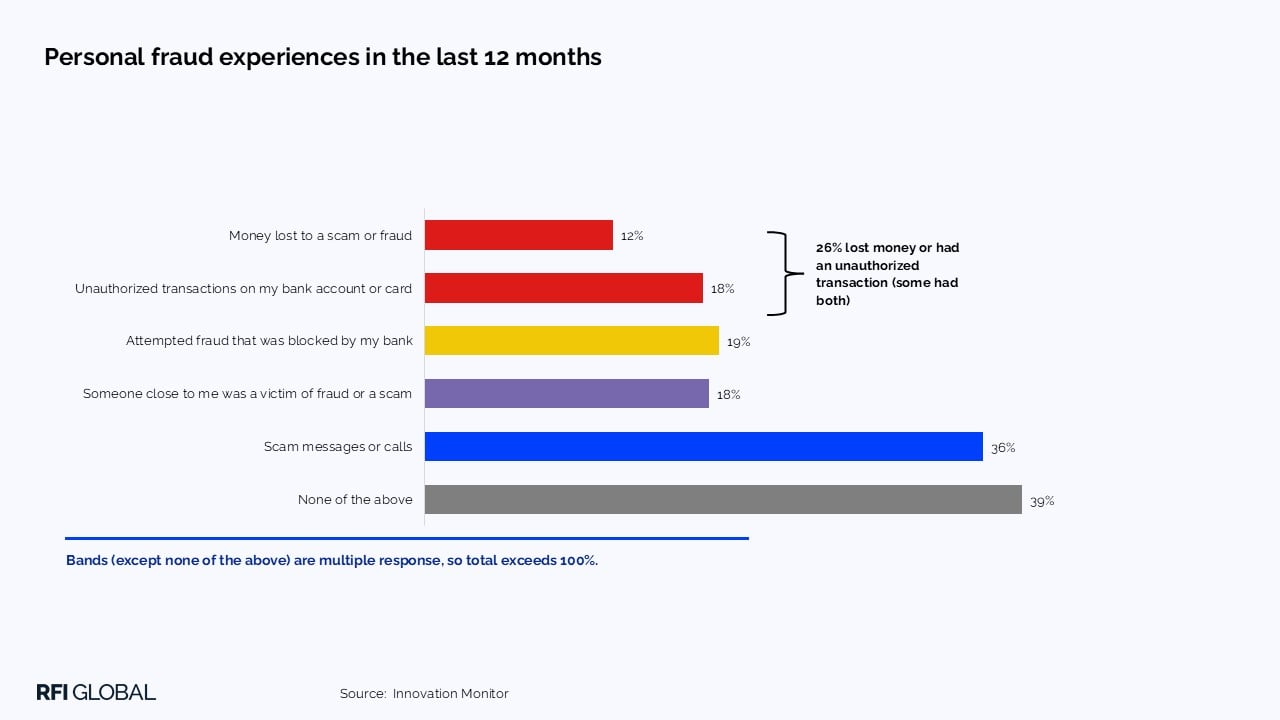
Yet most of this doesn’t reach the bank as a case. For 35% of the market, exposure stops at a scam message, an attempt on their account, or a friend or family member being defrauded. None of that raises a case or leaves a record, but half of this group have cut back on their payment activity anyway. Even among people who lost money to a scam, a quarter didn’t report it, and embarrassment over ’user-fault’ fraud is a likely reason.
The upshot is that every measure of fraud performance is calculated on the minority of incidents that produce a case. Most of the cost to trust and payment activity sits beyond it.
2. Banks resolve the case, but may not recover the relationship
On the surface, banks handle fraud well. 83% of customers who reported an incident were satisfied with how their bank handled it. But fewer than half (48%) were fully satisfied, and that gap matters.
Customers who are only somewhat satisfied are the ones leaving. They are far more likely than customers who didn’t report fraud to have moved activity to another provider (40% vs 25%) or fully switched their main bank (28% vs 11%).
The drivers of satisfaction depend on the incident. The outcome matters most where fraud is blocked. For people who lost money to a scam, clear communication throughout the process matters most, and for unauthorized transactions, it is speed of detection. Reimbursement alone isn’t the whole answer.
3. The real cost is in lost payment activity; even the protected pull back like victims
Fraud has broad-reaching implications. 79% of US consumers have consciously changed how they bank or pay because of fraud concerns. The most common responses to fraud are forms of self-imposed friction: monitoring accounts more closely (41%), double-checking even legitimate payments (29%) and being more cautious with digital payments or mobile banking (27%). Only around one in four lean more on their bank’s alerts and security tools.

The most striking finding is about customers the bank successfully protected. Consumers whose fraud attempt was blocked are as likely as victims (those who suffered actual losses) to spread their money across accounts or providers (23% vs 24%), and just as cautious about digital payments. A successful block saves the money, but not always the customer.
None of this appears on a fraud scorecard built around cases closed, money recovered and customers retained.
4. Clear guarantees are central to restoring confidence
Fraud protection influences how people pay. One in five US consumers (20%) say fraud protection is the single most important factor when choosing a payment method, ahead of speed (13%). Rewards come last of the seven factors, at 9%. Protection ranks at or near the top for every segment, whatever their experience of fraud.
When asked what would most increase their confidence in digital payments, consumers put greater protection or reimbursement first (24%), twice the number asking for clearer warnings (12%). Consumers are open to sharing the responsibility. 48% say responsibility for their financial security should be theirs or shared with their bank, while 31% say the bank should protect them in most situations.
What this means for banks
Fraud teams are measured on losses recovered, cases closed and customers retained. On those measures, many banks are doing well. But our research uncovers that the real cost to banks is the payment activity customers quietly hold back after an incident, including incidents the bank stopped.
To close the gap, banks need to:
- Treat a blocked attempt as an incident. Give protected customers the same reassurance as victims and help them reset their account security without needing a new provider.
- Make protection visible. Be clear about which payments a reimbursement guarantee covers, especially at checkout, so customers don’t build their own workarounds.
- Show what you’ve protected. Show customers the attacks you’ve fended off as well as those reimbursed to ensure you get credit for your vigilance. Think of all the junk mail a provider blocks – how many times has the bank fended off fraud attempts without the customer ever knowing?.
- Measure what the scorecard misses. Track transaction size, payment method mix and channel use in the 90 days after any incident to see whether activity really recovers.
Get in touch for further insights from the full report, including segment-level data and recommendations for banks, fintechs and technology vendors.
About the research
RFI Global’s Innovation Monitor is a nationally representative study of 4,000 US consumers aged 18–80, fielded online in June 2026. It tracks how customer needs, expectations and attitudes to innovation in financial services are changing twice a year.

Dan Latimore
Head of Research, North America
As Head of Research, North America for RFI Global, Dan helps clients make fact-based decisions about consumer behaviour and sentiment rooted in broad and deep primary research from MacroMonitor, Innovation Monitor and iSky.
View full profileFrequently Asked Questions about fraud in banking
Q: What is the impact of fraud on customer behavior?
Fraud concerns can influence how consumers bank and pay even when they do not suffer a financial loss. RFI Global research finds that 79% of US consumers have consciously changed their banking or payment behavior because of fraud concerns, including monitoring accounts more closely, double-checking payments and becoming more cautious about digital payments and mobile banking.
Q: How does fraud affect customer retention in banking?
Fraud can affect the banking relationship even after an incident has been resolved. RFI Global found that 83% of customers who reported fraud were satisfied with their bank’s handling of it, but only 48% were fully satisfied. Customers who were only somewhat satisfied were more likely to move financial activity elsewhere or switch their main bank.
Q: Do customers change their behavior even when banks prevent fraud?
Yes. Preventing a financial loss does not necessarily prevent behavioral change. Among consumers whose fraud attempt was successfully blocked, 23% spread their money across multiple accounts or providers, compared with 24% of fraud victims. This suggests that successful fraud prevention may protect the money without entirely preventing longer-term changes in customer behavior.
Q: What do customers expect from banks when it comes to fraud protection?
Customers place significant value on knowing they will be protected from financial loss. Almost two-thirds of consumers say a full reimbursement guarantee is more important than faster payments or higher rewards, indicating that reassurance around fraud losses can be an important part of the customer proposition.
Q. How should banks measure the impact of fraud?
Banks should look beyond fraud losses and incidents resolved to consider what customers do afterwards. 79% of US consumers have consciously changed how they bank or pay because of fraud concerns, indicating that measures of post-incident behavior can reveal an impact that traditional fraud metrics may miss.
Data-driven insights for financial service leaders
Subscribe to The Banknote, our monthly newsletter delivering expert perspectives and exclusive analysis, powered by 200,000 consumer and 60,000 business interviews each year to help you stay ahead in a fast-changing financial world.
