

Zafar Shah, Head of Research, Middle East
Ask UAE banking customers how satisfied they are with their main bank, and the chances are you’ll hear something positive. RFI Global’s H1 2026 Consumer Council survey puts average satisfaction at 8.6 out of 10.
But here’s where things get interesting: 98% of consumers use more than one financial provider, maintaining relationships with an average of 3.2 institutions. And just 55% of their financial products sit with their main bank.
So, while customers are generally happy with their banks, satisfaction alone is not enough to win their next financial product. The real challenge is understanding what customers need next and acting before competitors do.
Customers aren’t leaving – they’re adding banks
Just 6% of consumers have changed their main bank in the past five years. Yet since 2019, the average number of financial providers used has risen from 2.5 to 3.2, while products held have increased from 3.8 to 5.1. Main-bank satisfaction, meanwhile, has barely moved.
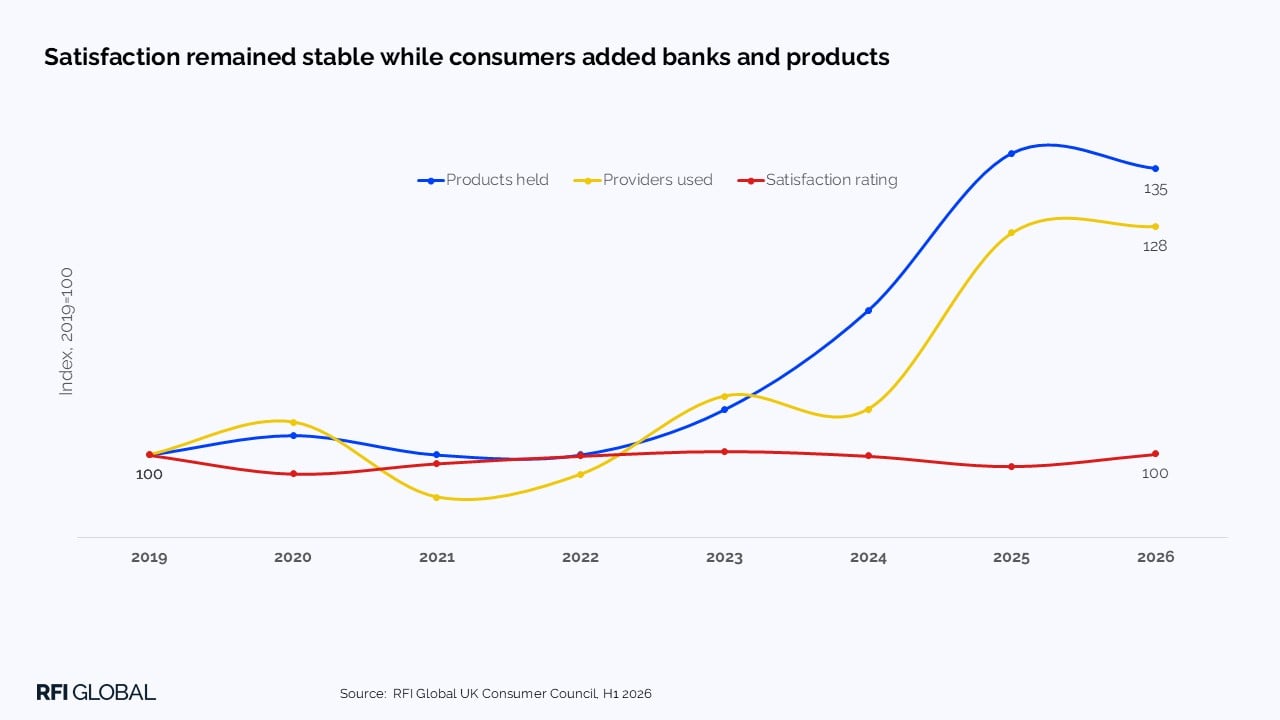
Two forces are contributing to this trend. Consumers are more willing to shop around rather than assume their main bank offers the best deal, with AI-powered tools making it increasingly easy to research and compare alternatives. Meanwhile, competition on price, features and advertising gives them more reasons to do so.
That’s good news for consumer choice, but tougher for banks, which face increasing pressure on margins and the need to invest in product development just to stand still. In other words, keeping a customer and growing the relationship are becoming two different challenges.
A salary relationship doesn’t guarantee the next product
Our research shows that salary transfer is the most commonly cited reason for choosing a main bank (49%), followed by bank reputation (47%) and service reputation (45%).
Salary may help establish the relationship, but it doesn’t necessarily make that bank the first choice for everything else. In fact, the main bank’s share of consumers’ product holdings has declined from 61% in 2019 to 55% in 2026.
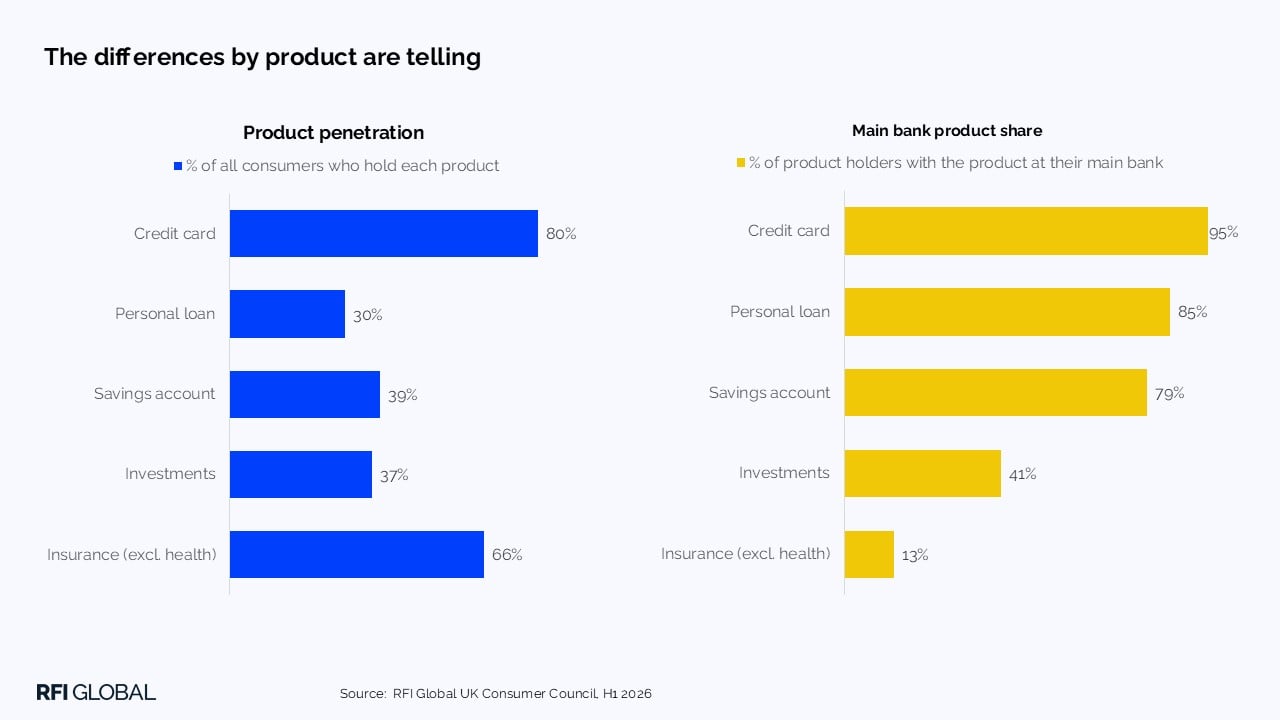
Core banking products remain concentrated with the main bank, but investments and insurance are much more likely to sit elsewhere. And the opportunity is growing: 22% of consumers say they’re likely to take up a new financial product within six months, up from 11% in 2024.
So, the growth opportunity isn’t limited to acquiring new customers. It also lies in capturing a greater share of existing customers’ financial needs. Understanding where they take their business, and why, is the starting point.
Digital works, but human interactions still matter
Banks have made significant progress in everyday banking, particularly digital. Our 2026 CX Tracker shows that 83% of personal banking customers are very satisfied with mobile banking. Satisfaction was lower for query resolution (75%) and complaint handling (73%). With fieldwork taking place during a period of regional disruption, these findings also serve as a timely reminder of the importance of reliable support and effective problem resolution when customers need it most.
Strong digital banking is increasingly an expectation. New app feature rollouts may improve convenience but won’t necessarily persuade someone to bring over their investments or next loan.
A branch visit, conversation with a relationship manager or a more complex complaint is different. Getting it right can build confidence; getting it wrong can put the relationship at risk. Better assisted experiences offer another way to stand apart.
So, what does it take to win?
Our data shows that there are three areas banks should prioritise:
1. Anticipate needs before customers shop around
Banks hold a wealth of customer information. Shifting transaction patterns, life stages, app activity and past conversations can signal emerging needs. The challenge is connecting these insights responsibly and acting at the right time. Market-wide insights and benchmarks add something internal data cannot: a view of what customers and competitors are doing.
2. Use technology to make human interactions better
Imagine branch or contact centre staff seeing relevant customer history and suggested next steps without asking people to explain everything again. Better information and intelligent prompts could help resolve complex issues faster, while automation handles simpler queries.
3. Compete on relevance, not price alone
Competitive rates still matter, but constant discounting is difficult to sustain. More tailored products, timely offers and non-financial benefits that genuinely matter to particular customers or segments offer another way to compete. If AI agents increasingly influence how people compare financial products, being distinctive on more than price could become even more important.
Satisfaction is important. But it isn’t the whole relationship
High satisfaction may help retention, but it doesn’t guarantee the next product. Salary transfer might establish the relationship, and good digital banking may help maintain it, but growth depends on understanding customers’ needs and acting before competitors do.
That’s the real challenge for UAE banks: not simply keeping customers happy but giving them a compelling reason to choose their bank again.
These findings draw on RFI Global’s extensive UAE retail banking research and CX tracker. Contact the team to discuss the latest customer trends, opportunities and implications for your business across the UAE and beyond.

Zafar Shah
Head of Research, Middle East
As Head of Research, Middle East for RFI Global, Zafar helps financial institutions better understand changing customer needs, identify growth opportunities and make more informed strategic decisions.
View full profileFrequently Asked Questions about banking in the UAE
Q: How satisfied are customers with banks in the UAE?
UAE banking customers report high levels of satisfaction. RFI Global’s H1 2026 Consumer Council puts average satisfaction with consumers’ main bank at 8.6 out of 10. However, high satisfaction does not necessarily mean customers hold all their financial products with that bank.
Q: How many financial providers do UAE consumers use?
UAE consumers have relationships with an average of 3.2 financial providers, up from 2.5 in 2019. Overall, 98% use more than one financial provider, while the average number of financial products held has increased from 3.8 in 2019 to 5.1 in 2026.
Q: How can UAE banks deepen customer relationships?
RFI Global research points to three priorities: anticipating emerging customer needs, using technology to improve human interactions, and competing on relevance rather than price alone. This matters as 22% of consumers say they are likely to take up a new financial product within six months, up from 11% in 2024.
Data-driven insights for financial service leaders
Subscribe to The Banknote, our monthly newsletter delivering expert perspectives and exclusive analysis, powered by 200,000 consumer and 60,000 business interviews each year to help you stay ahead in a fast-changing financial world.
