

Jackie Greig, VP Marketing, Global
Artificial intelligence has moved firmly into the mainstream, shaping how people search, shop, work, and increasingly, how they manage their money. While AI technology has been used in financial services for decades, adoption is now accelerating rapidly, with AI now embedded in everything from fraud detection and customer service to credit decision-making and personalised financial guidance.
However, as institutions are investing heavily in AI capabilities, consumer confidence is not keeping pace. RFI Global data shows that trust remains the main barrier to adoption.
Consumer concerns about AI are near universal
Concerns about AI in financial services are widespread, with the overwhelming majority of customers reporting reservations about its use.

In the UK, almost all consumers (98%) report concerns about AI in financial services, closely followed by Singapore (95%), Australia and Canada (94%), and Malaysia (93%). Even in markets with lower levels of concern, such as the United States and Hong Kong, more than four in five consumers still express reservations.
At the same time, financial institutions are operating in an increasingly competitive environment where customer loyalty is weakening. Switching intent is rising across key markets, with the US reaching a high of 25% of consumers considering changing their primary bank, up from 20% a decade ago. The UK follows at 19%, with Canada and Australia at 16% and 15% respectively.
Privacy, accuracy and lack of human connection drive consumer concerns
Privacy, accuracy and the need for human interaction alongside AI are the key hurdles to overcome in order to build consumer confidence in AI.

Privacy and data security are the most prominent concerns globally. In the US, 55% of consumers cite privacy risks as a key issue, and nearly half of UK consumers report similar worries. As AI relies heavily on analysing large volumes of personal financial data, concerns about how this data is stored, protected and used are central to consumer trust.
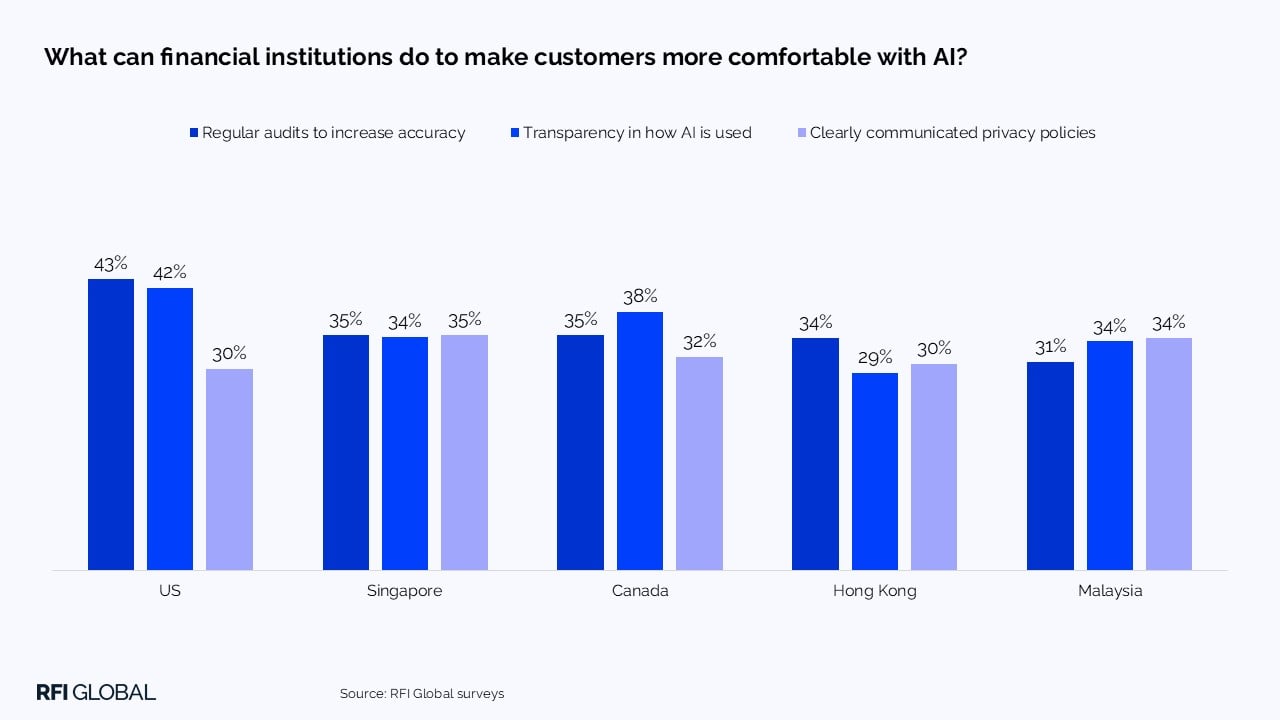
Concerns around accuracy and reliability are also significant. Consumers question whether AI systems can consistently deliver the right recommendations or decisions, particularly in high-stakes areas. This concern is especially pronounced in the US, where many consumers emphasise the need for regular audits to verify AI accuracy.
Loss of human interaction. Many consumers still expect personal touchpoints with their bank. Around half of consumers in the UK and the US are concerned about the lack of human interaction. While lower in other markets, it remains a concern. Financial decisions are often complex and emotionally significant, and many customers continue to value the reassurance that human engagement provides.
These concerns show that resistance to AI is not purely technological. It is also behavioural and emotional, rooted in trust, control and confidence.
What financial institutions must do to build confidence
Our data shows that consumers are clear about what would increase their comfort with AI in financial services.
Transparency is the most consistent theme across markets. Customers want clear explanations of how AI is used, what data is being analysed, and how decisions are made. Lack of visibility into these processes is a major contributor to distrust.
Strong privacy protection is also critical. Clearly communicated policies around data usage and security play a central role in building confidence, reflecting widespread concerns about how personal financial information is handled.
Consumers, particularly in the US, also place strong emphasis on regular audits to demonstrate the accuracy, fairness and reliability of AI-driven tools
Findings from Australia reinforce these themes while highlighting an additional priority around customer control. The most important factors influencing willingness to trial AI- powered banking are clear communication around privacy (29%), confidence in the accuracy of AI advice (23%) and the ability to retain full control over financial decisions (22%).
Adoption is strongest where AI supports decision-making rather than replacing it
Despite widespread concerns, consumers are more open to AI in use cases where the benefits are tangible and the perceived risks are low.
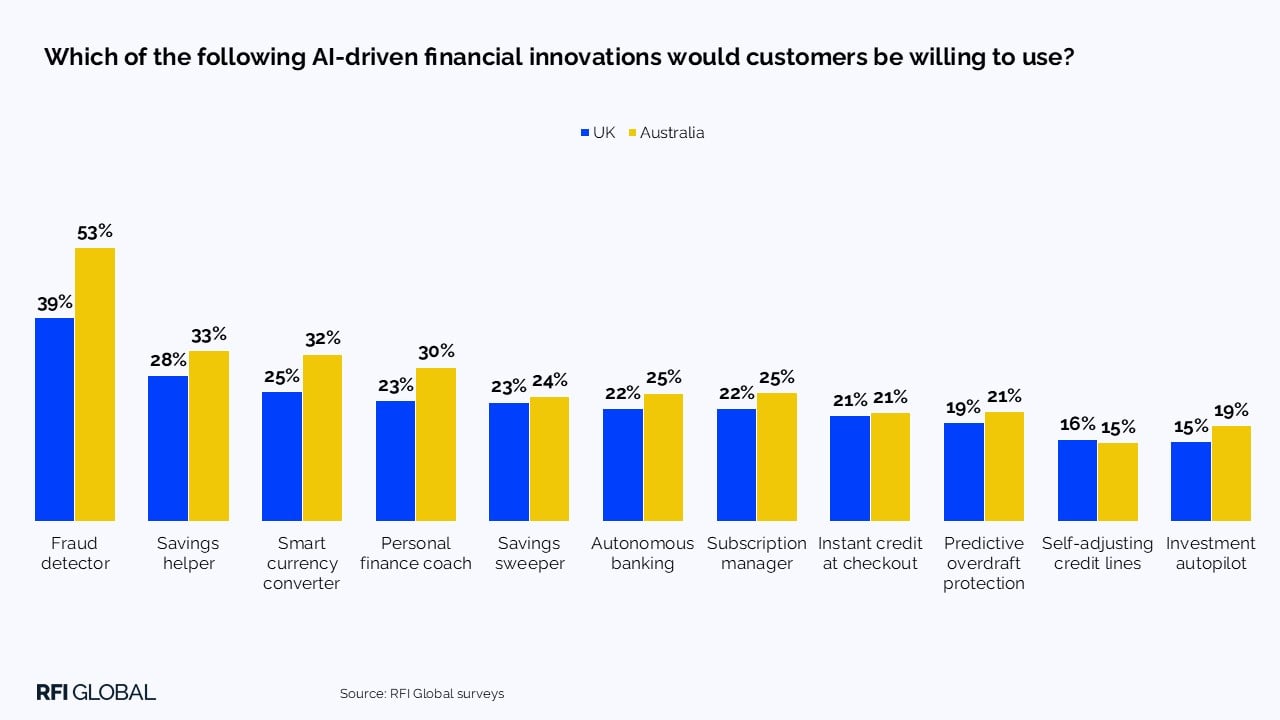
Fraud detection consistently ranks as the most accepted AI application globally, likely because consumers see clear security benefits from more advanced technology.
In Asian markets, consumer comfort is particularly strong, with openness reaching 74% in Hong Kong, 70% in Malaysia and 68% in Singapore. In contrast, North American consumers show more caution, with 50% of Canadians and just 23% of US consumers comfortable with banks using AI for fraud detection.
This reflects a strong alignment between consumer priorities and AI’s proven effectiveness. Fraud prevention is viewed as a protective, value-adding application, enhancing security rather than reducing customer control.
Beyond fraud prevention, interest is strongest in tools that help consumers manage their finances more efficiently in the UK and Australia, where around a third of consumers express willingness to use AI-driven savings helpers, personal finance coaching tools and automated budgeting solutions.
Conversely, applications involving higher levels of autonomy, like AI-managed investments or automatically adjusted credit limits, attract significantly lower levels of comfort. This indicates that consumers currently prefer AI that supports decision-making rather than replacing it entirely.
In the US, consumers are most comfortable with AI-powered chatbots and virtual assistants (23%), alongside fraud detection (23%) and credit scoring and loan approvals (16%). Robo-advisors remain a stretch, with only 8% expressing comfort using them.
Consumers in Hong Kong, Malaysia and Singapore demonstrate openness across a wide range of AI applications, including virtual assistants, fraud detection and AI-driven behavioural predictions, with 72% expressing interest. This suggests that familiarity with digital financial ecosystems plays an important role in shaping comfort with AI adoption.
Trust and transparency will define AI’s future in finance
AI adoption in customer-facing financial services is accelerating, but consumer trust is not keeping pace. Our data show that concerns around privacy, security, accuracy and the loss of human interaction remain significant barriers to wider uptake.
For financial institutions, building trust and confidence in the use of AI tools is essential. Transparency will be central in building that trust, with consumers expecting clear communication about how AI is used, how decisions are made, and how their data is protected. Demonstrating accountability and accuracy will play an equally important role in building confidence.
At the same time, human support remains important. Customers want AI to enhance their financial experience, not replace personal interaction. Hybrid models that combine AI-driven efficiency with accessible assisted channels will therefore be key to driving adoption.
Ultimately, the competitive advantage will lie with institutions that deploy AI responsibly, transparently, and in ways that strengthen customer trust and relationships.

Jackie Greig
VP Marketing, Global
Jackie Greig is the Global VP of Marketing at RFI Global. She is a senior marketing and market research leader with extensive experience building global marketing strategies for financial services brands.
View full profileFrequently asked questions about AI in financial services
Q: What are the biggest consumer concerns about AI in banking?
The biggest concerns are data privacy, security and accuracy. Many consumers worry about how their personal financial data is collected, stored and used, and whether AI systems can make reliable decisions in high-stakes situations. There is also significant concern about reduced access to human support when dealing with complex financial matters.
Q: Do consumers trust AI in financial services?
Trust in AI remains low across markets. RFI Global data shows that the overwhelming majority of consumers report concerns about AI use in financial services, even in digitally advanced markets. This trust gap is currently one of the main barriers to wider AI adoption.
Q: Which AI applications in banking do consumers accept most?
Consumers are most comfortable with AI applications that deliver clear, protective value. Fraud detection and prevention rank as the most widely accepted uses globally, followed by AI tools that help customers manage spending, budgeting and savings more effectively.
Q: How can financial institutions build trust in AI?
Financial institutions can build trust by prioritising transparency, clearly explaining how AI systems work and how customer data is protected. Strong governance, regular validation of AI accuracy and maintaining accessible human support alongside AI tools are also critical to increasing consumer confidence.
Data-driven insights for financial service leaders
Subscribe to The Banknote, our monthly newsletter delivering expert perspectives and exclusive analysis, powered by 200,000 consumer and 60,000 business interviews each year to help you stay ahead in a fast-changing financial world.
