

Jackie Greig, VP Marketing, Global
Sustainability has become a strategic priority for banks, driven by political, regulatory and consumer pressures to support more responsible financial practices. As awareness grows around climate change, social inequality and corporate accountability, more consumers expect financial institutions to act, not just comply.
Regulation sets the standard, but consumers set the expectation
In major markets worldwide, regulation has established a baseline for sustainability. In the UK, the Bank of England’s Prudential Regulation Authority and the Financial Conduct Authority have introduced climate-related requirements. The European Union’s Sustainable Finance Disclosure Regulation is in force, while the United States, Singapore and others have issued their own frameworks for disclosure and reporting.
Compliance is now expected. What distinguishes leading financial institutions is how they respond to growing consumer demand for sustainable products and transparent ESG commitments. Consumers are taking sustainability into their own hands. Platforms like Bank Green allow them to compare how environmentally responsible different banks and products are, helping them make more informed choices.
Understanding consumer motivations
RFI Global’s data from key markets shows that sustainability is influencing where consumers bank, how they save and invest and which institutions they trust. And we can see some interesting patterns emerging across markets both attitudinally and behaviourally.
While sustainability is an important decision factor for choosing financial institutions in all markets, our data highlights variations in attitudes and behaviours, with different consumer segments leading the change. What is consistent is that sustainability has become part of the financial decision-making process, driven by distinct demographic and market dynamics.
Consumer attitudes to sustainability
Consumer attitudes to sustainability are strong, with almost half of US consumers claiming they would only do business with sustainable companies, and one in five APAC consumers saying sustainability influences their choice.
United States: high expectations, especially among younger generations
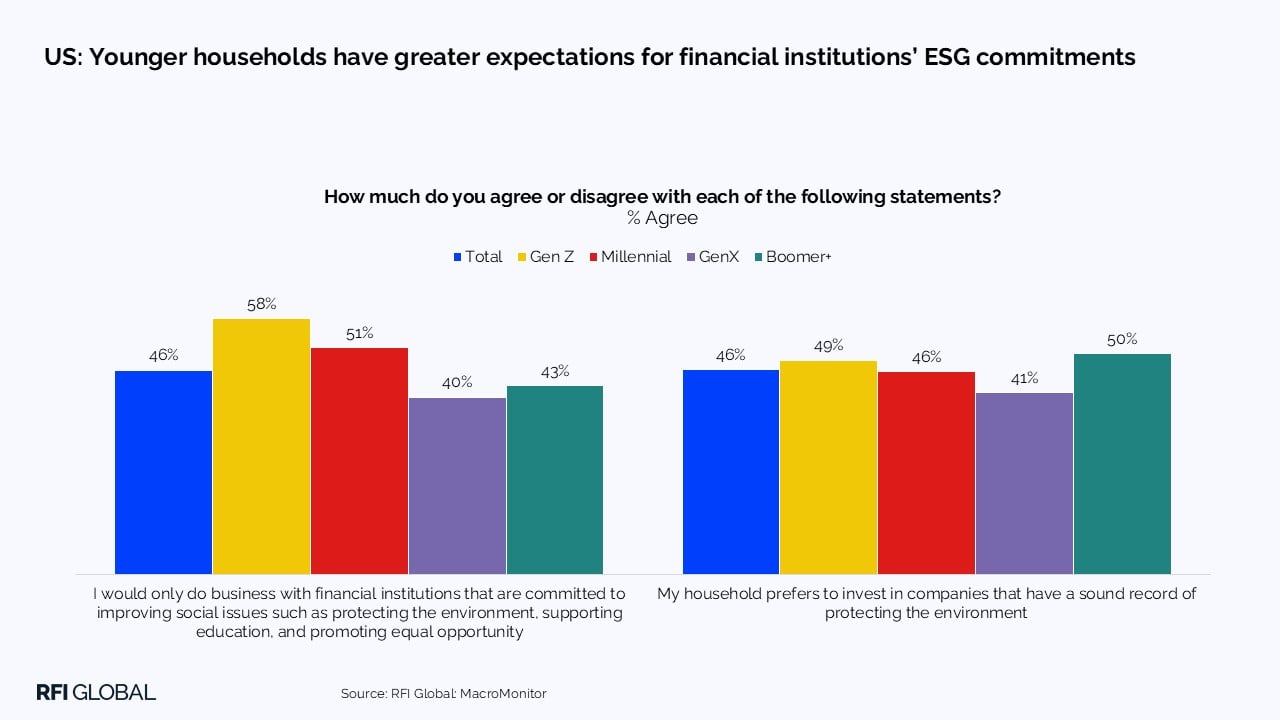
In the US, consumer interest in sustainability is high and is on an upward trajectory. Almost half of US households (46%) say they would only do business with financial institutions committed to improving social outcomes, such as protecting the environment, supporting education and promoting equal opportunity – up from 42% in 2022.
Generational differences are strong. The proportion claiming ESG influence climbs to 58% among Gen Z consumers, and to 51% among Millennials. Similar proportions across age groups report a household preference for investing in companies with a sound record of environmental responsibility.
This rising consumer expectation has encouraged major US institutions, including JPMorgan Chase and Bank of America, to embed sustainability into long-term strategy, with some pledging to achieve net-zero emissions in their lending portfolios by 2050.
APAC: One in five influenced by sustainability, with affluent consumers leading
In Asian markets, one in five or more consumers claim to be ‘more willing to make purchases from companies if they demonstrate a commitment to environmental sustainability’ (Hong Kong 24%, Malaysia 22% and Singapore 19%).
In contrast to other regions, this sentiment does not peak among younger consumers but instead among affluent and high-net-worth individuals. In Singapore, 28% of higher income earners express a strong interest in sustainable finance, rising to 30% in Malaysia and 22% in Hong Kong.
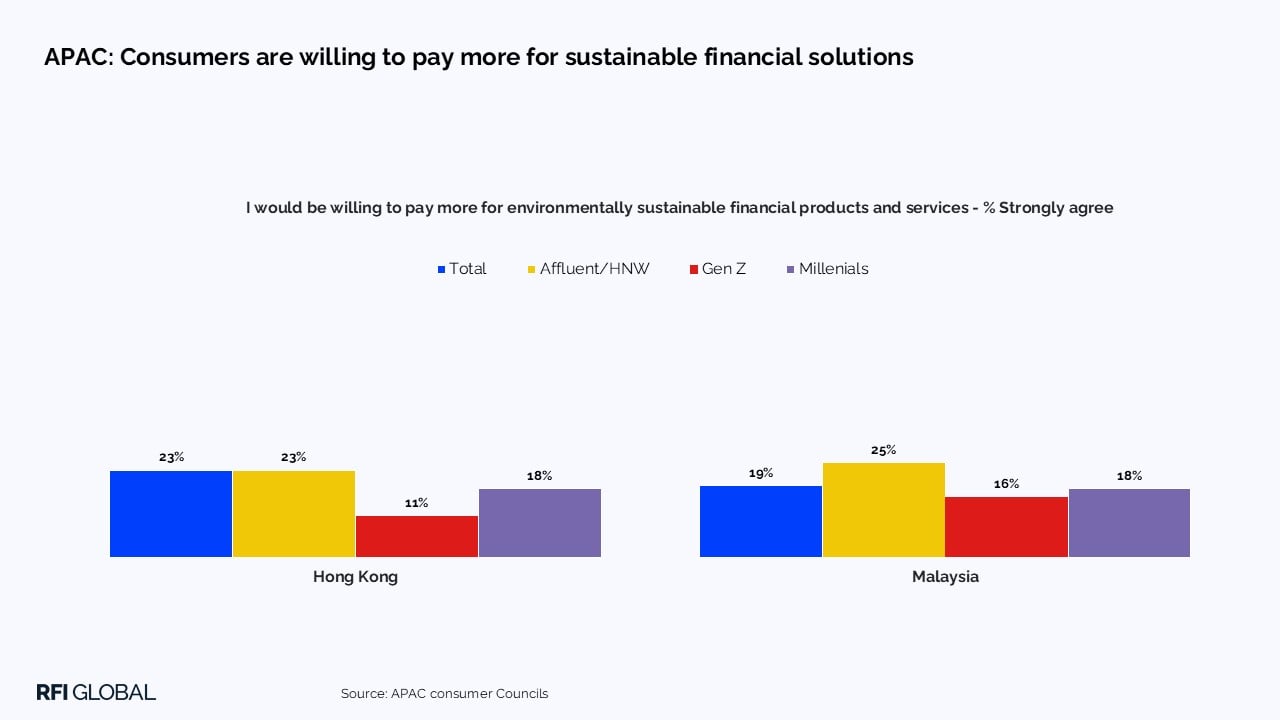
Of particular note, around one in five consumers in these markets say they are willing to accept lower returns or pay more for environmentally sustainable financial products and services – signalling that sustainability offers commercial value, not just reputational benefit.
The impact of sustainability on decision-making
These strong attitudes towards sustainability are translating into behaviour, influencing choice across financial products.
United Kingdom: Younger consumers are driving change
In the UK, 8% of consumers say that a provider’s ‘commitment to helping the environment and community’ is a reason for choosing a savings account. This rises to 12% among Gen Z and 11% among Millennials.
In terms of satisfaction with their main bank’s involvement in social and environmental causes, around half of UK consumers (53%) say they are very satisfied, with satisfaction peaking at 61% among Millennials. Gen Z, however, is less satisfied than the population overall (45% very satisfied), suggesting they hold higher expectations that providers are not yet meeting.
Awareness of banks’ ESG credentials also differs by age. Older consumers are far more likely to say they don’t know enough to rate their bank’s ESG initiatives (40%), indicating a degree of disengagement. In contrast, 87% of Gen Z feel informed enough to make a judgment, reinforcing that younger consumers are more engaged and more environmentally conscious.
While many factors, interest rates in particular, influence choice, the fact that 8% choose a savings provider for sustainability reasons is not insignificant. The higher proportions among younger consumers suggest that ESG considerations are becoming an increasingly influential factor in financial decision-making.
Australia: Sustainability matters more for younger consumers
In Australia, 7% of consumers cite ‘good green credentials’ as a reason for opening a savings account, and 8% for opening a transaction account. This influence is more pronounced among Gen Z Australians, where these proportions rise to 12%.
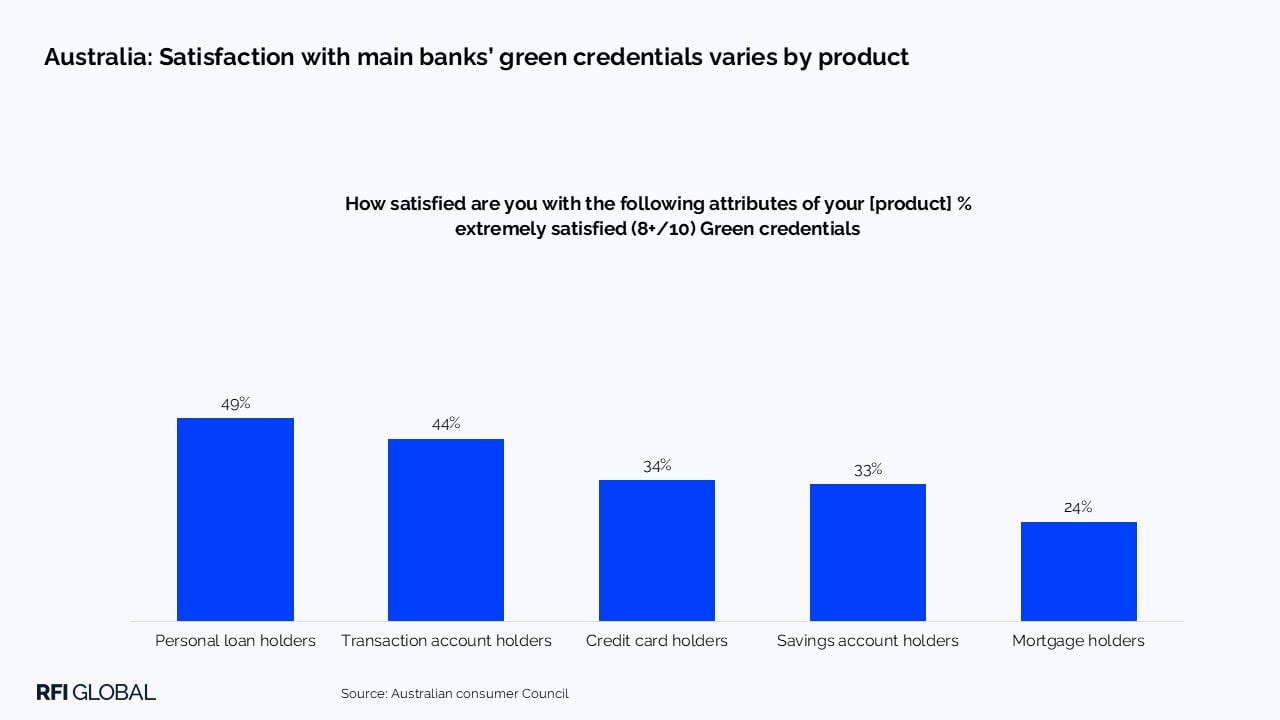
Satisfaction with sustainability performance varies by product. Half of Australian consumers are satisfied with the green credentials of their loan providers, but only a quarter are satisfied with their mortgage providers’ credentials. This highlights an opportunity for financial institutions to better communicate or strengthen their green credentials across all products.
What this means for financial institutions
Across markets, sustainability has moved from a corporate communications topic to a factor that actively influences consumer decision-making. However, the strength of this influence varies by market and by segment, but the direction of travel is clear. In most markets, younger generations are driving change, whereas in APAC, it is affluent and high-net-worth consumers.
For financial institutions, the implications are clear:
- Build authenticity. Consumers, especially younger ones, are quick to detect inconsistencies between stated ESG goals and actual practices. Transparency and measurable progress are essential.
- Adapt products and advice. Sustainable finance propositions, from green savings and loans to ESG-aligned investment portfolios, often resonate strongly with younger and affluent consumers.
- Engage and educate. Providers have an opportunity to lead the conversation by helping consumers understand how financial products contribute to environmental and social outcomes.
- Segment by generation and market. Strategies that resonate in the US or Singapore may not have the same impact in the UK or Australia. Understanding local sentiment is key.
Sustainability is now an important factor in how consumers choose their financial providers. Understanding attitudes and needs by market is essential to drive impact. For institutions that respond with integrity, innovation and transparency, the rewards go beyond compliance – they build lasting trust and competitive advantage.
Get in touch if you’d like to explore consumer attitudes and behaviours towards sustainability in more depth.

Jackie Greig
VP Marketing, Global
Jackie Greig is the Global VP of Marketing at RFI Global. She is a senior marketing and market research leader with extensive experience building global marketing strategies for financial services brands.
View full profileKey questions about ESG in banking
Q: How important is sustainability to banking consumers worldwide?
A: Sustainability is increasingly influencing consumer choices, with younger generations in the US, UK and Australia and affluent consumers in APAC, in particular prioritising banks’ ESG commitments.
Q: Which consumer segments are most engaged with sustainable banking?
A: Younger consumers in the US, UK and Australia and affluent and high-net-worth consumers in APAC, are most likely to prioritise ESG when choosing financial products.
Q: Which factors drive consumers to choose sustainable banks?
A: Consumers consider environmental responsibility, social impact and transparency when selecting banks, savings accounts, loans or investment products.
Q: What actions can banks take to meet ESG expectations?
A: Banks can build trust through authentic ESG strategies, tailor products for different segments, educate consumers on sustainable finance and communicate their environmental and social impact clearly.
Data-driven insights for financial service leaders
Subscribe to The Banknote, our monthly newsletter delivering expert perspectives and exclusive analysis, powered by 200,000 consumer and 60,000 business interviews each year to help you stay ahead in a fast-changing financial world.
